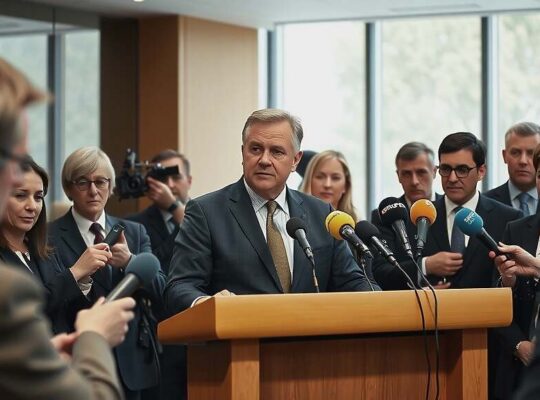
Thuringia’s Interior Minister Georg Maier has publicly voiced concerns regarding the progress and efficacy of the joint federal-state working group tasked with developing protocols for dealing with AfD (Alternative for Germany) members within government agencies and regarding firearms ownership. In remarks to the “Tagesspiegel” newspaper, Maier expressed disappointment, stating that “more could have been done” and that the group’s current outcomes are “not satisfactory.
The criticism comes amidst heightened scrutiny of the AfD following its designation by the Federal Office for the Protection of the Constitution as “reliably right-wing extremist” in May. This designation prompted a subsequent conference of Interior Ministers (IMK) in June, which subsequently established the working group to define common frameworks pertaining to civil service law, firearms regulations and security clearances, contingent on the confirmation of the AfD’s classification. The party is currently contesting this assessment through legal channels and authorities have pledged a period of restraint pending the court’s decision.
Maier’s reservations extend beyond general dissatisfaction with the working group’s output. He specifically called for a structured approach to civil service law, advocating for the establishment of “case groups” and defined tiers of assessment, moving beyond purely individual evaluations. He further emphasized the urgent need for legislative reform regarding firearms regulations, pointing to inconsistencies in judicial interpretation across different states. Maier underscored a zero-tolerance stance, insisting that “there is no room for interpretation” when it comes to preventing extremists from possessing weapons.
The Interior Minister’s critique extended to the federal government, singling out Interior Minister Alexander Dobrindt (of the CSU) and the broader conservative bloc (CDU/CSU). Maier accused them of displaying a “lack of commitment” regarding both civil service law and firearms control, characterizing their approach as “regrettable”. The assertion highlights a growing tension between the state government of Thuringia, a region heavily impacted by the AfD’s electoral success and the federal government’s perceived reluctance to proactively address the party’s ideological presence within state institutions. The working group’s shortcomings, coupled with Maier’s pointed remarks, suggest a potential clash of perspectives on how to respond to the evolving political landscape and the challenges posed by a party increasingly viewed as a threat to democratic values. The coming days, ahead of the Interior Minister’s conference, could see further debate and pressure for a more robust and coordinated federal-state response.