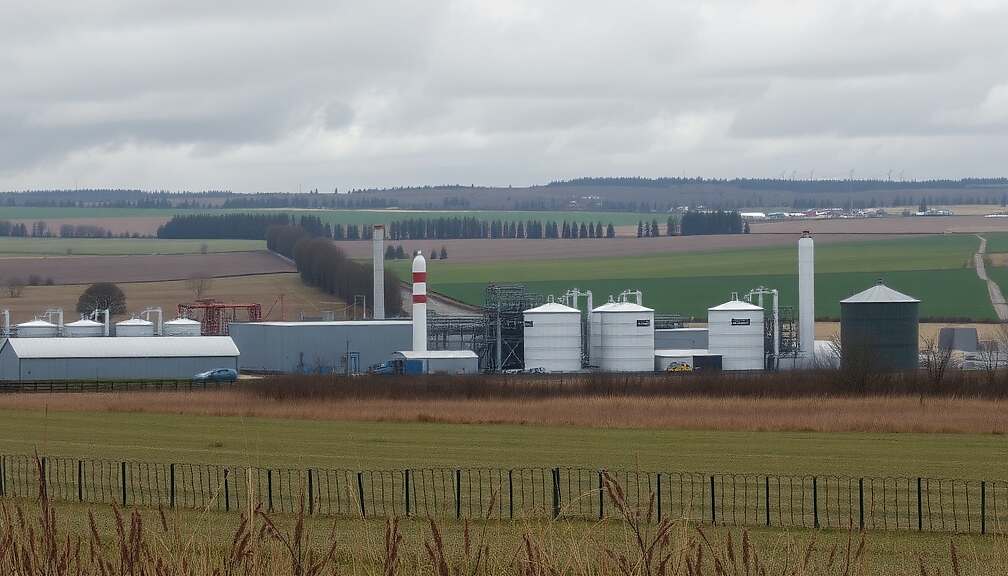
A major industrial facility in Baden-Württemberg is suspected of releasing substantial quantities of sulfur hexafluoride (SF6), a potent greenhouse gas, significantly exceeding previously reported figures. Investigative reporting by “Der Spiegel” and ZDF reveals that atmospheric scientists at the University of Frankfurt believe a chemical plant operated by a large corporation in the spa town of Bad Wimpfen is the primary source of the emissions.
SF6 is recognized as one of the most environmentally damaging substances ever produced by humanity. While odorless, colorless and non-toxic to humans, a single kilogram of the gas has a global warming potential equivalent to 24 metric tons of carbon dioxide (CO2) over a 100-year period.
The corporation reported emissions of just 56 kilograms of SF6 from the Bad Wimpfen site in 2023. However, the Frankfurt researchers estimate that the regional average for Southwest Germany between 2020 and 2023 was approximately 30 tons annually. This translates to an equivalent of 729,000 tons of CO2, a carbon footprint comparable to the annual emissions from over 250,000 internal-combustion engine sports cars or the entire volume of inner-German air traffic. If accurate, the majority of Germany’s total SF6 emissions could be attributed to the Bad Wimpfen facility.
In response to inquiries from the media outlets, the corporation stated that “all necessary, scientifically based measures” have been taken to “assess and continuously monitor the situation”. The extent of SF6 leakage remains undisclosed.
The Frankfurt researchers alerted authorities in 2023 regarding disproportionately high SF6 emissions in the Heilbronn district, prompting multiple meetings involving the Hessian and Baden-Württemberg environment ministries, the researchers themselves and company representatives.
The Green Party-led Baden-Württemberg environment ministry, headed by Thekla Walker, publicly questioned the Frankfurt study’s ability to definitively link the emissions to the Bad Wimpfen plant. While acknowledging the study, the ministry asserted it lacked the specificity needed to assign responsibility.
Initially, the ministry suggested alternative sources of SF6 within the Stuttgart administrative region, like energy providers and power plants, arguing that the company, a sole manufacturer of SF6 in Europe, wasn’t necessarily the culprit. However, under pressure, the ministry conceded that these alternative sources have been “excluded” as contributing factors.
Despite these assurances, evidence suggests the gas continues to leak. “We continue to observe a strikingly high level of pollution by SF6” stated atmospheric researcher Andreas Engel, highlighting the ongoing problem.
The situation raises serious questions regarding corporate transparency, the effectiveness of environmental monitoring and the adequacy of regulatory oversight in Germany’s industrial sector. The discrepancy between reported emissions and scientific findings demands a more rigorous and transparent investigation to assess the full extent of the damage and hold responsible parties accountable.