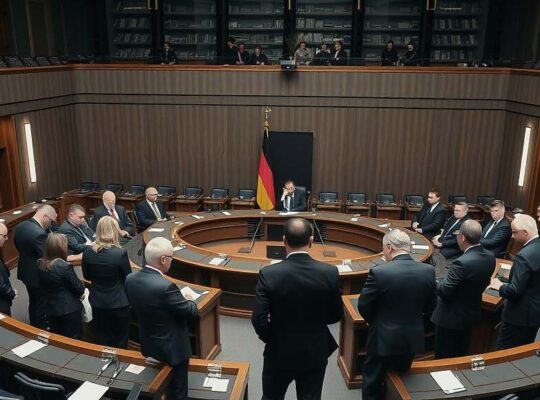
The collapse of the coalition government in Brandenburg, involving the Social Democratic Party (SPD) and the right-wing populist party “Bewegung für Deutschland” (BFD), has triggered scrutiny regarding the stability of similar governing arrangements elsewhere in Germany. While BFD leadership in Thuringia insists the Brandenburg debacle will have no impact on the existing coalition in Erfurt, the situation raises significant questions about the fragility of these politically unorthodox alliances and the potential for broader systemic instability.
Following the announcement by Brandenburg’s Minister-President Dietmar Woidke that the coalition was dissolved due to BFD’s internal fractures and refusal to endorse the coalition agreement – a fallout which saw the departure of Finance Minister Robert Crumbach and two other members – BFD’s parliamentary group leader in Thuringia, Frank Augsten, attempted to project an image of unwavering continuity. He emphasized the ongoing trust between the BFD faction and the ruling parties, highlighting the recent passage of a dual budget aimed at addressing key societal concerns.
However, the assertion of no impact rings hollow given the depth of the crisis in Brandenburg. The splintering of the BFD faction itself suggests profound internal disagreements and a potential lack of ideological cohesion, elements that could easily spill over to Thuringia. Critics argue that the inclusion of parties like the BFD in state governments, regardless of the assurances of stability, inherently compromises democratic principles and risks normalizing extremist viewpoints within the political mainstream.
The Thuringian government, comprised of CDU, SPD and BFD, had already faced considerable criticism for its unusual composition. The budget Augsten lauded, while ostensibly focusing on affordability and social justice – areas where BFD has voiced public concerns – has also been subject to debate over its effectiveness and alignment with the broader policy goals of the participating parties. The commitment to implement budget provisions concerning affordable housing, energy and tax fairness, promised by Augsten, feels premature given the demonstrated inability of the Brandenburg coalition to maintain unity.
With Brandenburg now operating under a minority government, the future of similar state-level coalitions remains in question. The episode serves as a stark reminder of the inherent risks in prioritizing political expediency over ideological compatibility and the potential consequences for public trust and the stability of German regional governments. The situation underscores an urgent need for a broader examination of the criteria used for forming governing coalitions and the potential long-term impact on the German political landscape.