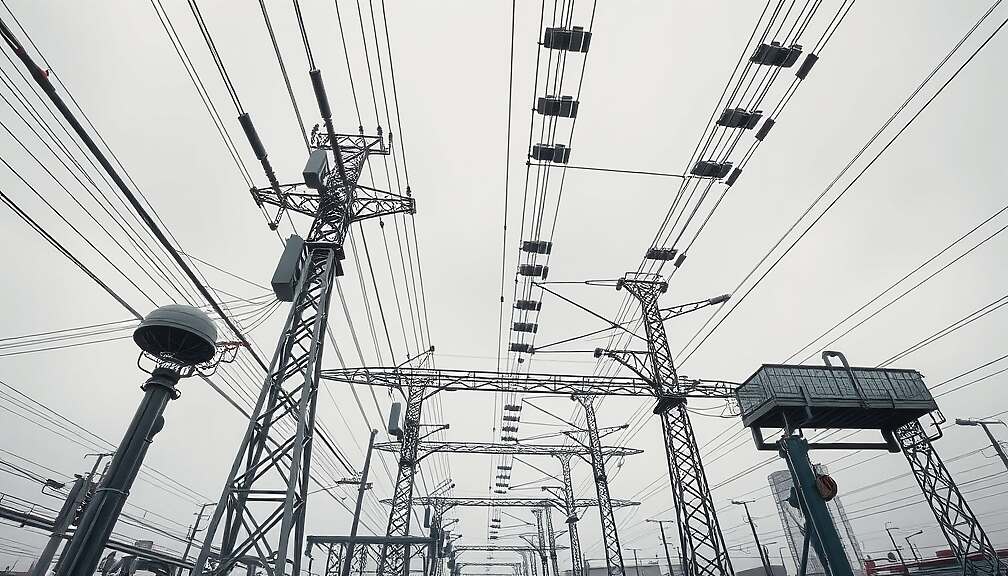
The recent disruption to Berlin’s power supply has sparked a sobering assessment of Germany’s energy infrastructure security, with the Association of Municipal Utilities (VKU) openly acknowledging the impossibility of achieving complete protection against targeted attacks. A spokesperson for the VKU, in statements released to Funke-Mediengruppe newspapers, emphasized that while network operators consistently maintain essential services, the sheer scale and geographic distribution of Germany’s power grid renders it vulnerable to sophisticated disruption.
The admission underscores a growing anxiety surrounding critical infrastructure, particularly in the context of heightened geopolitical tensions and evolving security threats. While officials maintain that Germany’s energy system benefits from a decentralized and redundant design – incorporating, for example, duplicate transformers at major substations to mitigate individual failures – the vulnerability exposed by the Berlin incident raises serious questions about the adequacy of current preventative measures.
The VKU’s advice to citizens to prepare for potential outages, echoing recommendations from the Federal Office for Civil Protection and Disaster Assistance, reflects a shift in responsibility. By encouraging individual preparedness, the government appears to be subtly acknowledging a reliance on citizens to buffer the impact of disruptions, a tactic that also avoids explicitly detailing vulnerabilities that might be exploited by potential adversaries.
Critics argue that the incident highlights a systemic underinvestment in the hardening of crucial infrastructure, with resources historically prioritized for modernization and renewable energy integration over defensive security upgrades. The focus on decentralization, while offering resilience against localized failures, may also inadvertently complicate a unified and coordinated response to large-scale, coordinated attacks. The VKU’s reassurance of stability in most cases downplays the potential for cascading failures across interconnected systems, a risk that requires far more robust and transparent assessment. The need for a comprehensive rethinking of energy security protocols and a sustained commitment to proactive defense strategies is now urgently apparent, moving beyond reactive damage control to a proactive and demonstrably resilient infrastructure.