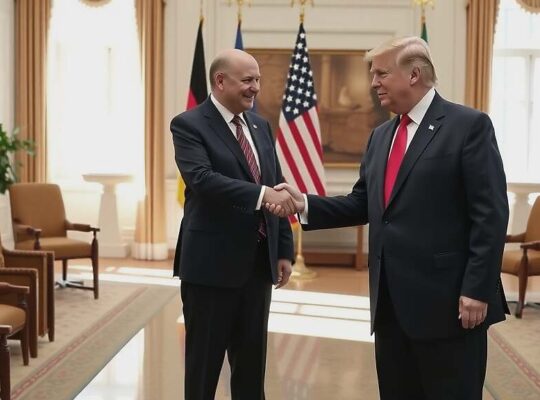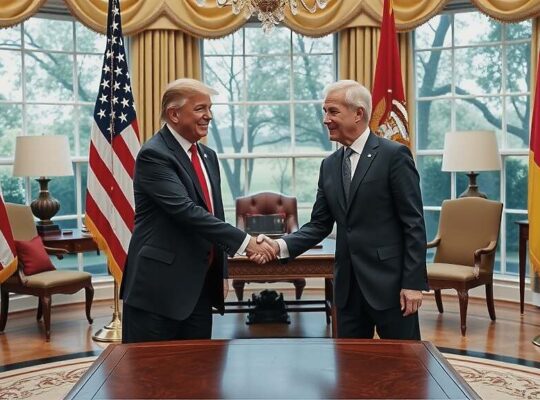
The prospect of renewed negotiations between Danish and American officials in Washington regarding Greenland has been overshadowed by a fresh assertion of U.S. claims to the Arctic island, delivered directly by former President Donald Trump. On his Truth Social platform, Trump reiterated the U.S.’s national security rationale for acquiring Greenland, linking it directly to a proposed project dubbed the “Golden Dome” and controversially suggesting NATO should facilitate the acquisition. He cautioned that failure to secure the territory could result in it falling into the hands of Russia or China, adding further fuel to a simmering geopolitical debate.
Trump’s continued insistence on obtaining Greenland has triggered significant discomfort among U.S. allies in recent weeks, escalating tensions that threaten to undermine transatlantic unity. The impending meeting, scheduled for Wednesday afternoon and involving U.S. Vice President JD Vance, Secretary of State Marco Rubio, Danish Foreign Minister Lars Lokke Rasmussen and Greenland’s Minister for Foreign Affairs, Vivian Motzfeldt, is intended to address these mounting concerns and potentially explore avenues for compromise.
However, the undercurrents of Trump’s statements remain stark. He leveraged the discussion to underline the U.S.’s perceived dominance within NATO, claiming that without American military power, the alliance is functionally weakened and incapable of effective deterrence. This assertion, thinly veiled as a justification for potentially circumventing Danish sovereignty, raises critical questions about the future of transatlantic relations and the willingness of the U.S. to prioritize its own strategic interests over the established norms of international governance and established partnerships.
Analysts suggest Trump’s rhetoric isn’t simply a resurgence of a previously abandoned idea but rather a calculated maneuver aimed at leveraging geopolitical pressure ahead of potential electoral campaigns, subtly questioning NATO’s effectiveness and reinforcing his narrative of American exceptionalism and unilateral action. The meeting in Washington promises to be a tense and closely watched event, with implications extending far beyond the Arctic region and impacting the fragile balance of power within the Western alliance. The Danish government’s response and the potential willingness of Greenland’s leadership to engage, will be pivotal in determining whether Trump’s ambitious and potentially destabilizing, vision finds any tangible form.