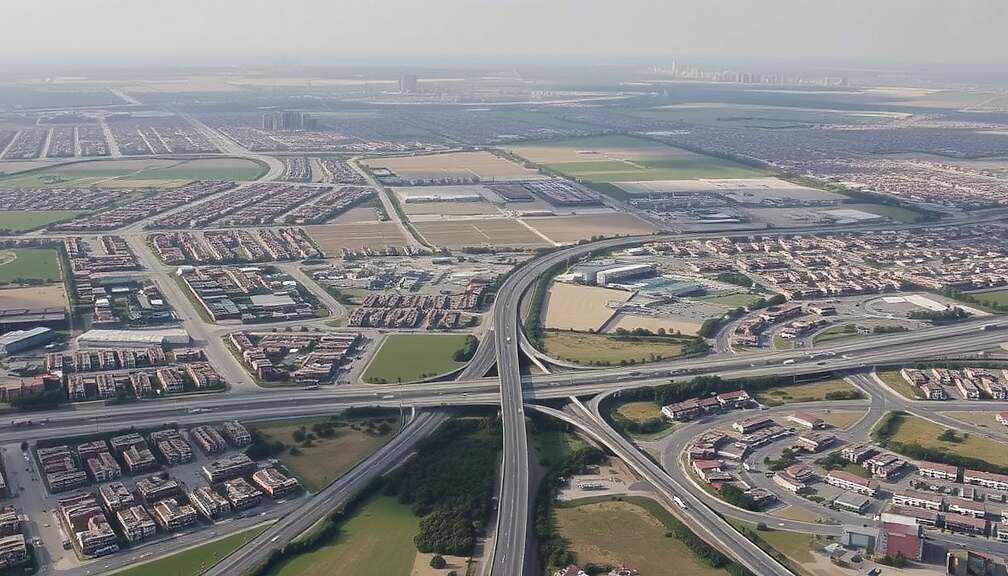
Germany continues to grapple with a persistent and concerning trend of land consumption, raising questions about the efficacy of current government policies and broader sustainability goals. Official data released this week by the Federal Statistical Office (Destatis) reveals that the area dedicated to settlements and transportation expanded by an average of 50 hectares (approximately 124 acres) daily between 2021 and 2024. While this represents a slight deceleration from the 51 hectares per day observed in the preceding period (2020-2023) and a marginal decrease from the 49 hectares recorded between 2019 and 2022, the rate remains stubbornly high.
The growth is predominantly driven by the relentless demand for residential construction, industrial and commercial development and public facilities, accounting for an average of 36 hectares per day during the 2021-2024 period. Expansion of recreational areas, including sports fields, parks and cemeteries, added another 14 hectares daily, while transportation infrastructure saw comparatively negligible increases.
Currently, settlements and transportation constitute 14.6% of Germany’s total land area – approximately 5.2 million hectares. Of this, 3.4 million hectares are designated for settlements, encompassing not only buildings but also associated spaces like gardens and even mining operations, while 1.8 million hectares are dedicated to transport.
The German government’s sustainability strategy aims for a drastic reduction in this daily expansion rate, targeting a limit of less than 30 hectares by 2030. An even more ambitious goal – a ‘circular land economy’ – envisions a scenario by 2050 where no net additional land is consumed for settlement or transport purposes. However, the current trajectory casts serious doubt on the feasibility of meeting these objectives.
Critics argue that government initiatives have been insufficient to curtail land consumption, pointing to a combination of factors including inadequate enforcement of existing regulations, a persistent housing shortage fueling urban sprawl and a lack of sufficient incentives for brownfield redevelopment. Furthermore, the statistic should be considered within the context of Germany’s broader land use composition: with 83.1% of the country’s 35.8 million hectares devoted to vegetation – primarily agriculture (50.2%) and forestry (29.9%) – the loss of even relatively small areas to settlement represents a significant ecological impact. The remaining 2.3% is dedicated to waterways.
The ongoing trend necessitates a fundamental reassessment of urban planning strategies, building policies and economic incentives if Germany hopes to genuinely embrace sustainable land management and achieve its professed environmental goals. The current rate of expansion signals not only a continued degradation of valuable ecosystems but also an impending challenge in balancing economic development with environmental protection.