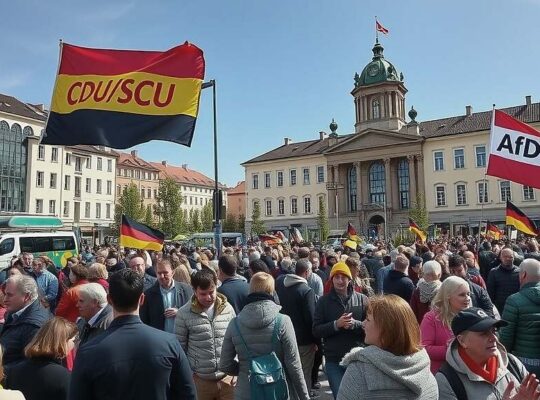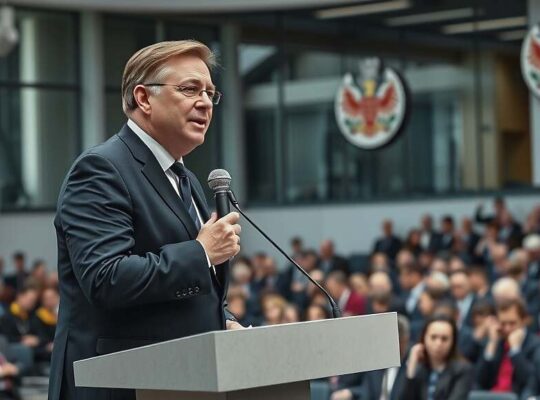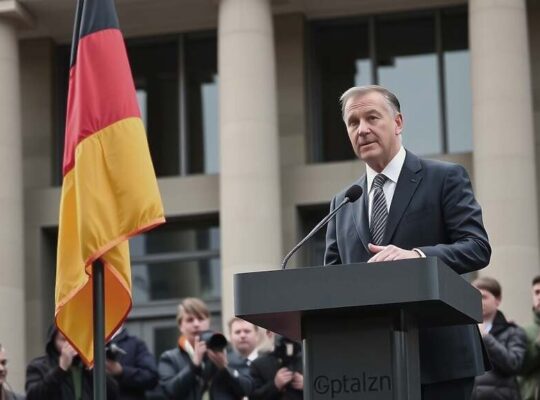
The Thuringian Minister-President Mario Voigt of the Christian Democratic Union (CDU) has publicly urged for a more measured and less reactive approach to the Alternative for Germany (AfD), signaling a potential shift in the CDU’s strategy towards the increasingly prominent far-right party. In an interview with “Der Stern”, Voigt dismissed the AfD as an “illusory giant” attributing part of its perceived significance to media attention. He simultaneously challenged his own party to cultivate greater confidence and resolve.
Voigt’s remarks come amidst a backdrop of political turbulence across Germany, with the federal government struggling to consolidate its position and facing internal divisions. He expressed frustration with what he described as a pervasive “lack of courage” within the CDU, stating that it needed to adopt a more proactive stance.
Reflecting on his own administration’s near-year in power, Voigt presented a strikingly positive assessment, particularly highlighting the stability and reliability of the Bavarian State Party (BSW) as a governing partner. He asserted that Thuringia had demonstrated its capacity for stable governance in a challenging political environment, a point he believes has garnered renewed respect for the region amongst those who previously held dismissive views. The experience gained in navigating compromises and shouldering responsibility, he contends, positions Thuringia as a valuable lesson for the struggles now being faced in Berlin.
Voigt voiced surprise and concern at the internal conflicts plaguing the federal coalition, emphasizing the urgency of decisive action, especially regarding the contentious issue of pension reform. He argued that extended debates are unsustainable given the current state of the nation and that a consensus, however difficult to achieve, is now essential. He acknowledged that diverse opinions must be voiced, but stressed a critical need to move towards resolution, suggesting a disconnect between the federal government’s performance and the public’s expectation for effective governance. His words implicitly criticize the slow, deliberative pace of decision-making within the ruling coalition, hinting at a belief that the CDU in Berlin needs to adopt a more assertive and results-oriented approach.