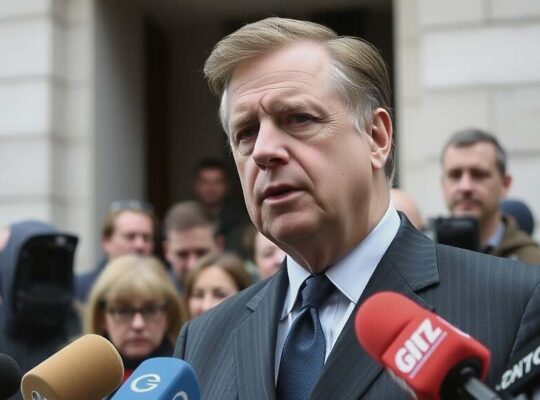
The chairman of Yad Vashem, Israel’s Holocaust memorial, has effectively blocked a request from Ukrainian President Volodymyr Zelenskyy to address a local audience in Israel, a decision raising complex questions about the framing of contemporary conflicts through the lens of historical trauma. Dani Dayan, in a statement to the Neue Osnabrücker Zeitung, confirmed he denied Zelenskyy’s request to speak before an audience of 300 guests with a global broadcast, shortly after Russia’s initial invasion of Ukraine.
Dayan’s rationale centered on the critical need to safeguard the historical specificity of the Holocaust. He cautioned against equating the war in Ukraine, however devastating, with the systematic genocide of European Jewry during World War II. “Not every war crime is a genocide and not every genocide is a Holocaust” Dayan asserted, emphasizing the imperative to preserve the distinct character of the Shoa.
The decision, while not indicative of a lack of solidarity with Ukraine, reflects a burgeoning sensitivity within Israel regarding the potential for politicization of Holocaust memory. Yad Vashem’s position acknowledges a delicate balance: supporting Ukraine’s struggle against aggression while simultaneously upholding the integrity of Holocaust remembrance. This sensitivity is further complicated by the historical reality that, during the Holocaust, there were instances of collaboration between Ukrainian locals and the Nazi regime, a reality that Dayan specifically referenced in his reasoning.
The controversy was amplified when Zelenskyy subsequently delivered a pre-recorded address to the Israeli Knesset, which included multiple, direct comparisons between the current conflict and the Holocaust. This appearance, while demonstrating a clear alignment of national interests, drew considerable criticism within Israel for what some viewed as an inappropriate blurring of historical lines. The incident underscores the increasing politicization of the Holocaust in the context of contemporary geopolitical struggles, forcing institutions like Yad Vashem to actively defend the boundaries of historical accuracy and avoid the dilution of a uniquely tragic event. The incident reveals a potential point of friction within Israeli-Ukrainian relations, highlighting the profound emotional and historical weight attached to Holocaust memory.