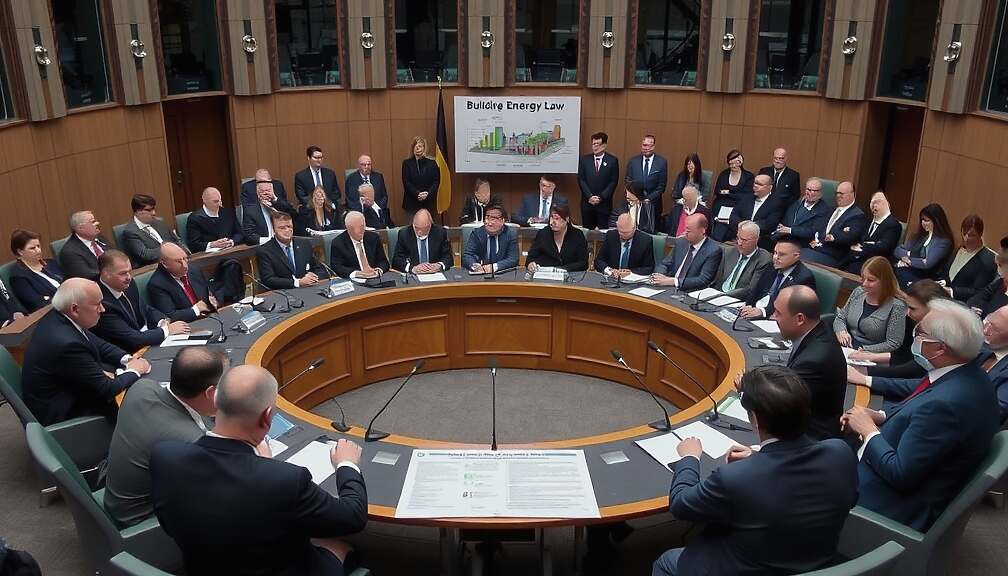
Union and the SPD have reached a agreement on reforming the Building Energy Act.
Under the new rules the requirement that new heating systems must be powered by at least 65 % renewable energy will be dropped, as will the ban that had been repeatedly tightened on old heating boilers. Buyers will no longer be subject to mandatory advisory duties, and municipalities with fewer than 15,000 residents will not have to carry out a municipal heat‑planning exercise.
Instead, from 2028 a “green‑gas quota” will be introduced for existing buildings, starting at up to 1 % of the building’s heat supply. This share will be increased regularly to raise the proportion of green hydrogen and biogas. New gas and oil boilers that are installed from 2029 must contain at least a 10 % bio‑fuel component, and by 2040 the quota will rise in three further steps whose exact levels are still to be agreed. In 2030 the reform will be evaluated to determine whether the climate targets remain achievable.
Jens Spahn, the CDU’s parliamentary group leader, said on Tuesday evening: “We’re taking away the Habeck heating law. The heating cellar will become a private matter again. Citizens will have the freedom to decide how they heat their homes”.
SPD parliamentary leader Matthias Miersch added, “We entered the negotiations with different ideas. The old heating law will be abolished, but a new building‑modernisation law will replace it. Consumers will in the future have the liberty to make their own choices. I will have to calculate what that might cost me”.
A recent study by the employer‑oriented Institute of German Economics (IW) and Wuppertal Institute found that the gas network cannot be operated climate‑neutral by 2045 because sufficient biomethane and green hydrogen would not be available. The shortage could lead to sharply higher gas prices for households, a warning the Paritätische Gesamtverband calls a “cost trap”. Experts recommend directing biomethane and green hydrogen primarily to industry sectors such as cement and steel production, which can otherwise be made climate‑neutral only at prohibitive costs.
The government must replace the 65 % rule with an alternative climate‑protection solution, as it is required to submit its climate‑protection programme by 25 March. The programme, in line with the Federal Climate Protection Act, must outline how all intermediate climate targets up to 2040 will be met. Dropping the 65 % renewable requirement without an adequate substitute would widen the CO₂‑reduction gap through 2040.