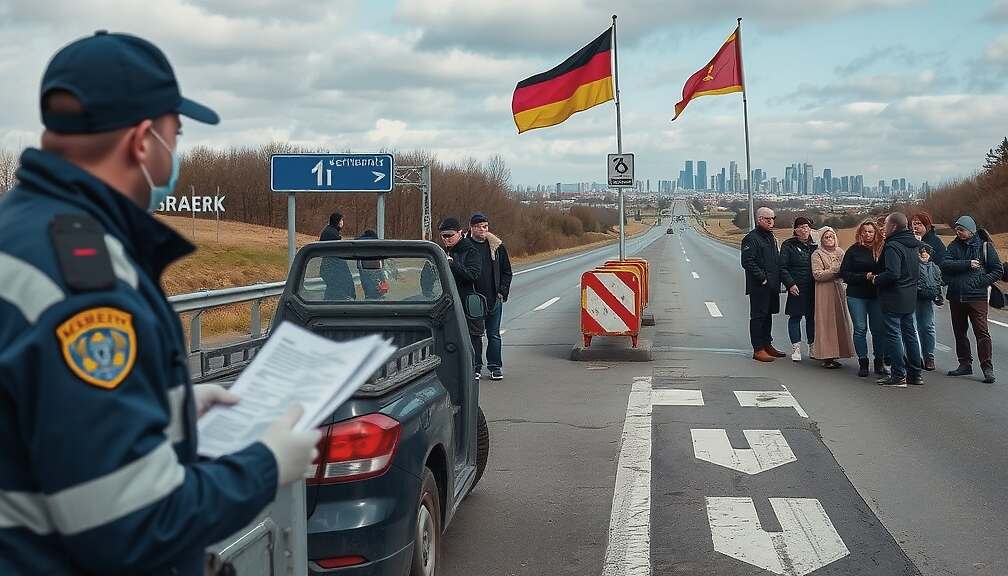
The German federal government is under pressure to justify the ongoing refusals of asylum seekers at German borders. “The legal ice is getting thinner” said Konstanz asylum‑law expert Daniel Thym to the news magazine “Focus”. He explained that the refusals are partly due to the likelihood that an exceptional situation will be harder to assume. In addition, the new Common European Asylum System will come into force on 12 June 2026. “Thus the federal government will struggle to argue that applying the regular EU rules is unbearable because they do not work” Thym added.
The refusals are highly disputed under EU law, because member states are obliged to examine asylum applications. The federal government invokes an EU emergency article that allows national law to override European law when “a danger to public safety and order” exists. Among the state cabinet leaders of the 16 federal states, opinions differ on whether the refusals should continue.
The interior ministers of the coalition federal states stand by the measure. “I support the federal interior minister’s decision to maintain border controls” said Baden‑Württemberg’s migration and justice minister Marion Gentges in an interview with “Focus”. “Border controls have had a noticeable impact on the declining migration numbers in Germany” the CDU politician added.
Bavaria’s interior minister Joachim Herrmann characterises the refusals as a worldwide signal for a shift in migration policy. “The era of naive migration policy is over. As long as European external borders are not secured consistently, we must continue taking national responsibility” he stated.
Saxony’s interior minister Armin Schuster (CDU) views the refusals as a successful first step of the asylum turn. “In the second phase of the asylum turn, we will focus clearly on enforcing the departure obligation” he said.
Lower Saxony’s interior minister Daniela Behrens (SPD) remains sceptical. “The legal assessment is not yet fully clarified” she said. “I do not see a state of emergency for Lower Saxony given the sharp decline in arrivals this year” she added. Behrens warned of the risk of overburdening the Federal Police. “From a state perspective, it is essential that the Federal Police remain fully capable of handling their other tasks-such as securing train stations and airports, or supporting the states in repatriations-completely”.
Bremen’s integration senator Claudia Schilling (SPD) also expressed criticism. “Every person is entitled to a lawful asylum procedure” she said. “That must be guaranteed. From a labour and social policy standpoint, I want us to also focus on integration and participation”. Schilling noted that many of the people who come to us are young and bring talents that we should not leave unused, especially in light of the skilled‑worker shortage in the labour market.