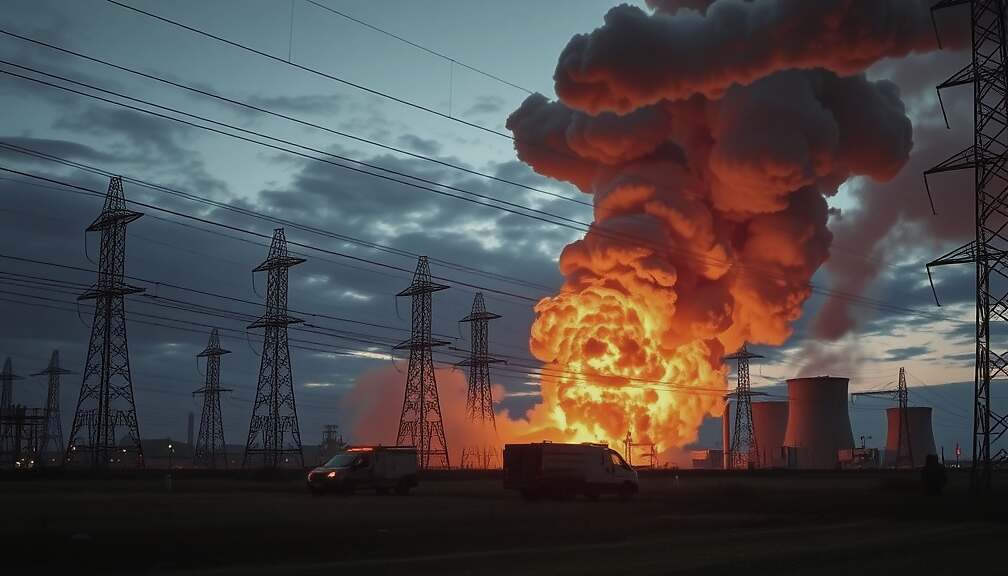
Attacks on critical infrastructure in Germany are on the rise, according to “Welt am Sonntag”, which cited a survey of all 16 federal states.
In Hamburg, the number of assaults on power plants and military facilities has doubled over the past year, as reported by the state’s interior authority. Brandenburg and Lower Saxony also record higher incident counts. Between 2019 and 2024, Lower Saxony logged a total of 208 attacks on businesses, infrastructure, justice facilities and the armed forces. In 2025 alone, a “high double‑digit” number of cases were added.
When concrete evidence emerges, investigations frequently point to the far‑left extremist milieu. In North Rhine‑Westphalia, the interior ministry states that of the 445 attacks on the electricity network since 2019, 425 (around 95 %) can be traced back to politically left‑motivated perpetrators. A similar pattern is seen in Hesse: between 2015 and 2024, the region recorded a middle double‑digit number of sabotage incidents, the majority of which were attributed to far‑left extremists. The Federal Criminal Police Office (BKA) recorded 321 sabotage‑suspected cases nationwide last year, with a focus on North Rhine‑Westphalia and Lower Saxony.
The Brandenburg Interior Ministry declared that “the threat landscape posed by ideologically motivated sabotage has qualitatively changed”. Earlier acts were largely symbolic vandalism; current acts increasingly target supply‑chain disruptions. Within the far‑left spectrum, growing technical expertise regarding the vulnerability of technical networks is also evident.
Analysis of manifesto writings shows that actors deliberately choose infrastructure nodes with low redundancy to maximise outages. “This includes not just the power grid but also railway routes” the authorities noted from Potsdam. Security agencies observe a rising willingness among these actors to accept serious consequences by crippling critical infrastructure.
Information on critical infrastructure is recommended to be handled more restrictively in the future. “We must not build a digital glass house while people outside await with stones” warned former Brandenburg interior minister René Wilke (SPD). Hessen’s interior protection minister Roman Poseck (CDU) added: “We need to scrutinise transparency rules for critical infrastructure so that open information does not become a security risk”.
CDU/CSU floor spokesman Alexander Throm told “Welt am Sonntag” that the trivialisation of left‑wing terrorism must finally end. SPD colleague Sebastian Fiedler referred to a “very serious” threat situation and called for a nationwide unified situational picture. Green party spokesman Marcel Emmerich described the protection of critical infrastructure as “still riddled with holes like Swiss cheese”.