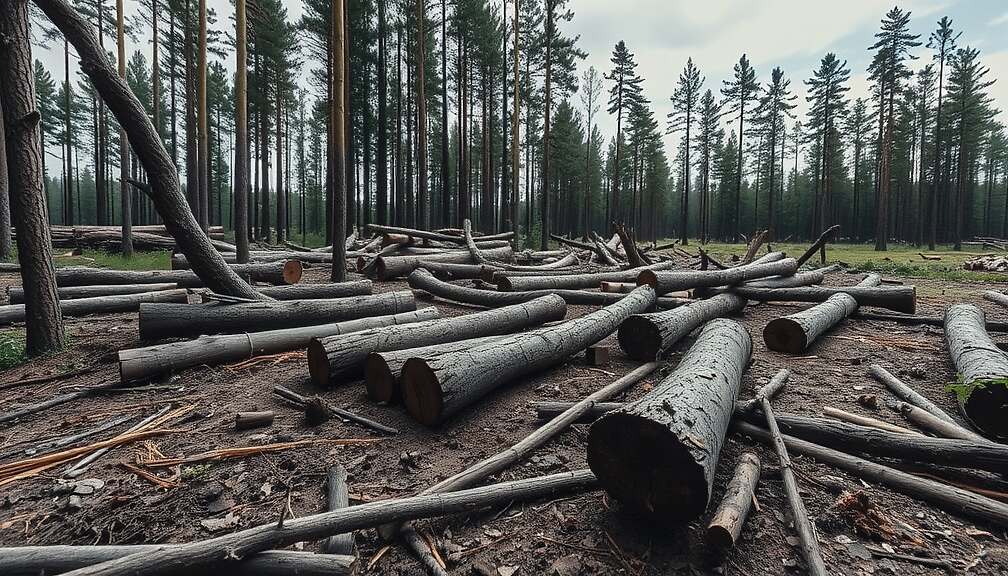
In 2025, German forests saw a total logging volume of 57.3 million cubic meters. This figure marks a 6.4 percent decrease compared to the previous year’s total of 61.2 million cubic meters, according to data released by the Federal Statistical Office (Destatis).
The decline was primarily attributed to a significant drop in salvaged timber-wood harvested due to forest damage. In 2025, 12.7 million cubic meters of salvaged wood were logged, representing a 53.7 percent fall from the previous year’s 27.3 million cubic meters. This marks the fifth consecutive year of decline for salvaged timber, which had reached its highest level since 1990 in the record year of 2020 (60.1 million cubic meters in total salvage). Consequently, salvage timber’s share of the total logging dropped to 22.1 percent in 2025, down from nearly three-quarters (74.8 percent) in 2020.
More detailed breakdowns revealed that 7.9 million cubic meters of salvaged wood were collected due to insect damage in 2025. This was roughly half (53.1 percent decrease) of the amount logged in 2024 (16.8 million cubic meters), and nearly four-fifths (81.8 percent decrease) compared to the record salvage year of 2020 (43.3 million cubic meters). Other notable causes for logged damage included drought and wind and storm damage. These categories also showed marked reductions compared to the previous year: wood logging due to drought decreased by 27.7 percent from 2.5 million cubic meters in 2024 to 1.8 million cubic meters in 2025. Similarly, the logging associated with wind and storms fell by 66.7 percent, dropping from 3.5 million cubic meters the year before to 1.2 million cubic meters.
In 2025, a total of 32.4 million cubic meters of coniferous wood-specifically spruce, Douglas fir, and other softwood-were harvested. This represents a decrease of 14.3 percent compared to 2024 (37.7 million cubic meters) and a substantial 48 percent reduction compared to the peak logging year for this group in 2020. Despite the decrease, spruce remained the most commonly available wood type. Pine and larch followed with 13.2 million cubic meters, while the group of beech and other hardwoods accounted for 9.9 million cubic meters. Oak and red oak wood totaled 1.9 million cubic meters.
The much lower logging volumes compared to the years 2020 and 2021, which were heavily influenced by bark beetle outbreaks (both in insect-related salvage and spruce logging), suggest that the majority of damaged trees were already felled and removed from the forest in preceding years. Spruce stands are considered particularly vulnerable to pest infestations, especially if they have already been weakened by drought or other factors.
The salvaged timber was primarily channeled into the sawn and veneer industries for the purpose of producing structural wood, such as pallet or parquet lumber. In 2025, 32 million cubic meters-making up 55.9 percent of the harvested material-were logged with the intended use for structural wood. Approximately 11.8 million cubic meters (20.6 percent) were intended for the wood product industry, including paper and pulp. The remaining 10.7 million cubic meters (18.7 percent) were earmarked for energy generation.