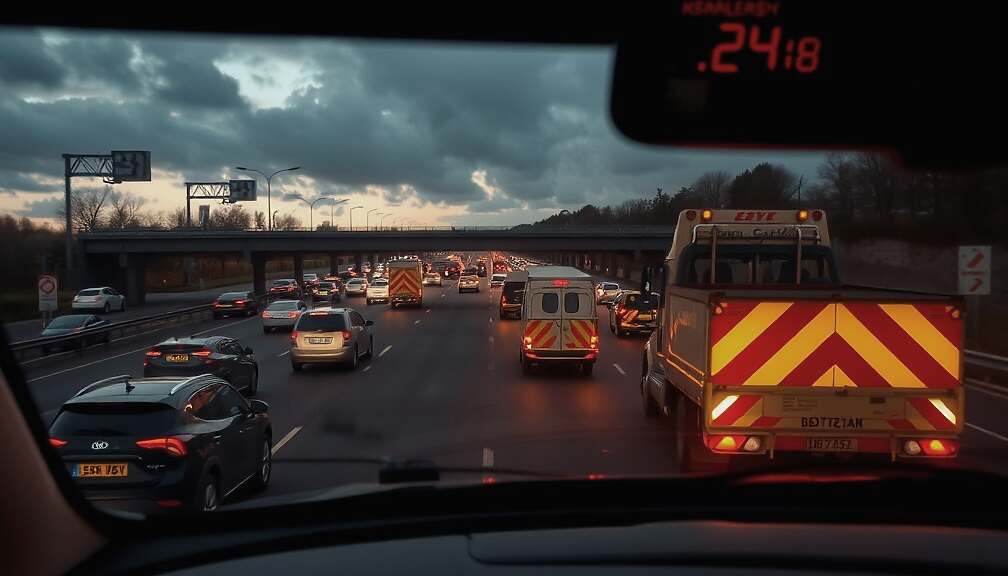
According to an analysis conducted by WDR, Nordrhein-Westfalen (NRW) is disproportionately affected by traffic issues, hosting two-thirds of all nationwide highway construction sites and roughly a third of all traffic jams. When examining the state’s 20 busiest commuter routes, drivers lose an average of one hour and fifty-one minutes per week to blockages and construction during peak hours. The commute between Cologne and Bonn is particularly severe, where the combined time loss exceeds three hours weekly-amounting to almost six days annually.
The study, which utilized GPS data from a navigation provider, focused on the major commuter axes surrounding Cologne, Düsseldorf, and the Ruhr area. Most commuters drive, and frequently, they face traffic congestion. The degree of delay varies significantly depending on the specific route. While the Köln-Bonn corridor suffers the most extreme delays, drivers traveling between Bochum and Dortmund manage comparatively well, losing only around 41 minutes per week. Conversely, commuters making the journey between Essen and Düsseldorf lose upwards of two hours. The A52 has long been identified as one of Germany’s most congested autobahns, recently ranking highly in the ADAC traffic report for hours lost per kilometer.
The analysis also pointed out that even short trips into urban centers are heavily impeded. For example, the route from Frechen to Cologne is significantly shorter than the Bonn-Cologne route, yet drivers experience an average delay of 82 percent during rush hour-the highest percentage among all 20 routes examined. In some areas, the density of traffic heading toward the city center causes navigation systems to recommend longer detours via the highway.
Adding to the difficulty is the widespread nature of construction work, as hardly any major stretch of motorway is currently free of a construction site. This leads to questions about the effectiveness of coordination among the various stakeholders. A digital reporting system, known as the Traffic Information Center (TIC), is available precisely for this purpose, allowing construction sites and closures to be centrally recorded and checked for conflicts. However, not all parties are participating in this process. Oliver Krischer, the NRW Transport Minister, told WDR that currently only about 25 percent of municipalities utilize the digital construction tool, but he noted that mandatory use of the system will begin next year.
Traffic and delay researcher Michael Schreckenberg argued that the lack of communication cannot be blamed solely on local municipalities. He pointed out the clear hierarchy when it comes to construction projects. “The railway is at the very top” Schreckenberg stated. “The railway simply announces its projects; coordination in that environment is almost impossible”. Krischer acknowledged the enormous pressure for quick renovations across the state, explaining that many sites must be processed rapidly and cannot tolerate delays, invariably resulting in intense overlap effects.
Criticism was also directed at the organization of some roadworks. Krischer admitted, “There are construction sites where the contractors are not forced to work quickly because the projects were simply awarded based on price”. Roman Suthold, a traffic expert at the ADAC, emphasized communication deficits, stating, “The issue fundamentally lies with the communication. In my view, 50 percent of the problems stem from this”. Despite current efforts, he does not anticipate a quick relief for commuters. “Unfortunately, I fear the situation won’t improve for the next 10 to 15 years, because we have deferred a massive investment backlog that must now be addressed-and we are feeling the effects of it on the roads”.