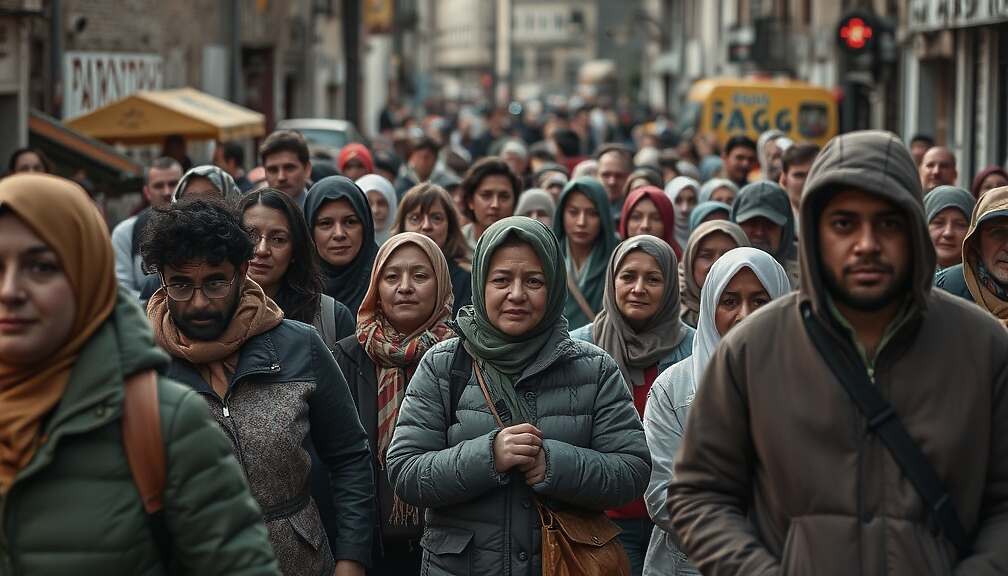
In 2025, Germany was home to over four million people who immigrated for reasons of flight, displacement, or to seek international protection. According to preliminary data from the Federal Statistical Office (Destatis), a total of 3.3 million people have immigrated due to flight and displacement since 1950. This figure is supplemented by an additional 713,000 individuals who are displaced persons from the Second World War and migrated before 1950.
Focusing on the 3.3 million immigrants who arrived due to flight, asylum, or international protection since 1950 and still reside in Germany today: one-third of this group (1.2 million) arrived between 2014 and 2021, and another third (1.1 million) arrived between 2022 and 2025. Furthermore, 476,000 current residents fled to Germany between 1990 and 2000, often due to conflicts in the former Yugoslavia. In 2025, these refugees averaged 39 years of age, with 45 percent being women and 55 percent being men.
Regarding their origins, one in four (25 percent, or 832,000 people) of the 3.3 million immigrants was born in Ukraine. Similarly, nearly one in five people (22 percent, or 732,000 people) hailed from Syria. These two countries combined comprise almost half of all refugees living in Germany in 2025 who arrived since 1950. Other significant countries of origin include Afghanistan (316,000), Iraq (186,000), Turkey (146,000), Poland (120,000), and Iran (117,000).
When measured against the total population of the federal states, Bremen (7.3 percent) had the highest proportion of immigrants who arrived due to flight and displacement since 1950, followed by Hamburg (6.3 percent), Saarland (5.7 percent), and Hesse (4.8 percent).
The 713,000 displaced persons from the Second World War are defined as individuals born in former German territories as German citizens who migrated to the current borders of Germany before 1950, having been displaced, fled, or expelled in connection with the WWII events. In 2025, these World War II displaced persons were, on average, 85 years old, with 61 percent being women and 39 percent being men.
In terms of population share, Mecklenburg-Vorpommern had the largest concentration of these displaced persons (2.3 percent), followed by Saxony-Anhalt (1.5 percent), Brandenburg, and Thuringia, each accounting for 1.4 percent.