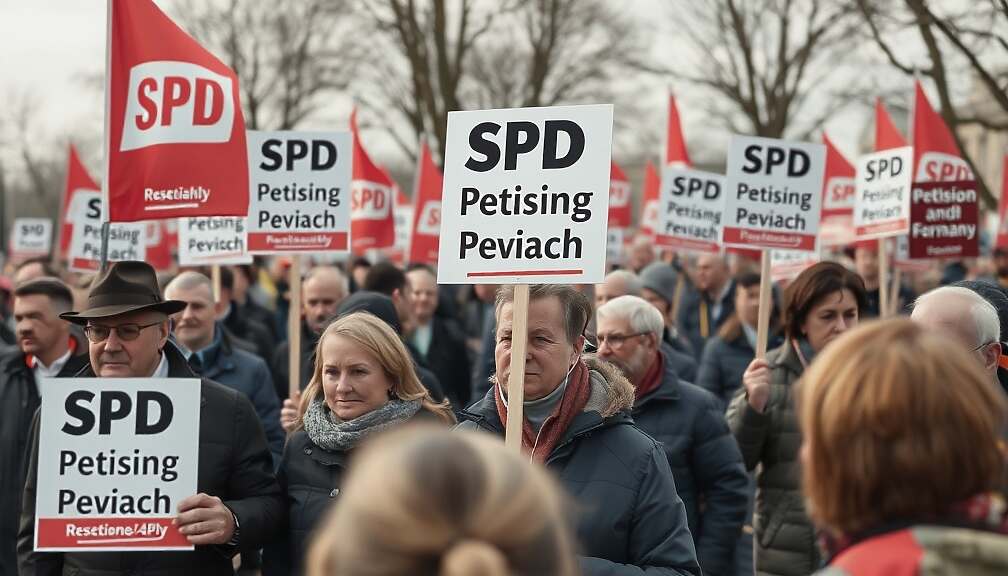
Resistance among SPD campaigners in Eastern Germany against the pension package proposed by the black-and-red coalition government is growing, according to reports from Funke Media Group newspapers.
Armin Willingmann, the SPD’s top candidate for the state elections in Saxony-Anhalt, called the proposal by the Age Security Commission-to abolish the uncapped pension after 45 years of contributions-a genuine problem, noting that countless others face the same issue. He argued that many people in East Germany, having worked for decades, rely on the certainty of retiring without deductions after 45 contribution years, and this is considered both reasonable and just.
Willingmann stressed that reforms should be balanced, particularly for Social Democrats. He challenged the justification posed by the commission, which cites increasing life expectancy for the new rule, arguing that this directly collides with the fact that life expectancy in Saxony-Anhalt is actually decreasing. He also asserted that if his party imposes such a measure on citizens, the SPD must clearly demonstrate what it is achieving in return. Willingmann added that suggesting a higher wealth tax elsewhere does little to convince people in Saxony-Anhalt, as comparatively few would be affected, concluding that this does not constitute a balanced overall package.
Manuela Schwesig, the Minister-President and SPD candidate in Mecklenburg-Vorpommern, likewise criticized the pension commission’s proposal regarding contribution years and rejected the implementation of the package without changes. This stance mirrored those of Chancellor Friedrich Merz (CDU) and SPD Party Chair Bärbel Bas, while Steffen Krach, the SPD candidate in Berlin, had already called for a clear regulation for those who must retire after years of strenuous work. Elections are scheduled for September in Saxony-Anhalt, Mecklenburg-Vorpommern, and Berlin.
Willingmann made it clear that he does not expect the suggestions of the Age Security Commission to be implemented verbatim. The SPD politician stated that simply demonstrating the capacity to act is insufficient; people must feel that the reforms are balanced. Furthermore, he called on the federal government to drop its controversial decision regarding the sick leave notification process.
The Science Minister of Saxony-Anhalt criticized the mandatory requirement to report sick leave beginning on the first day of illness, stating that it raises suspicion among employees and places strain on a healthcare system already operating at its limit. He argued that restricting telephone reporting of illness, combined with the new mandate, is logistically unmanageable. Using this instance, the SPD candidate alleged that the coalition sometimes loses touch with practical reality in Berlin. He claimed that mere calls to a Minister of Economics or the Doctors’ Association would have been enough to realize the policy could not function as written. Consequently, he stated it was highly possible that he would not survive the parliamentary procedure in its current form.