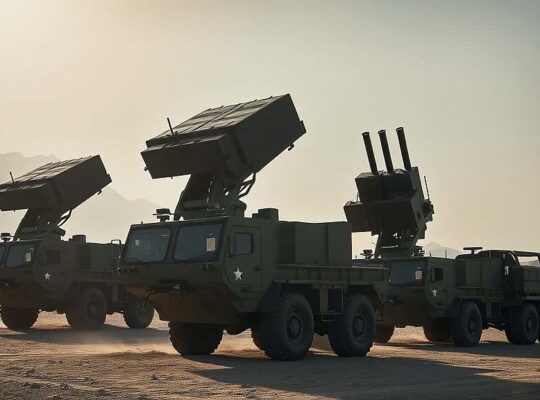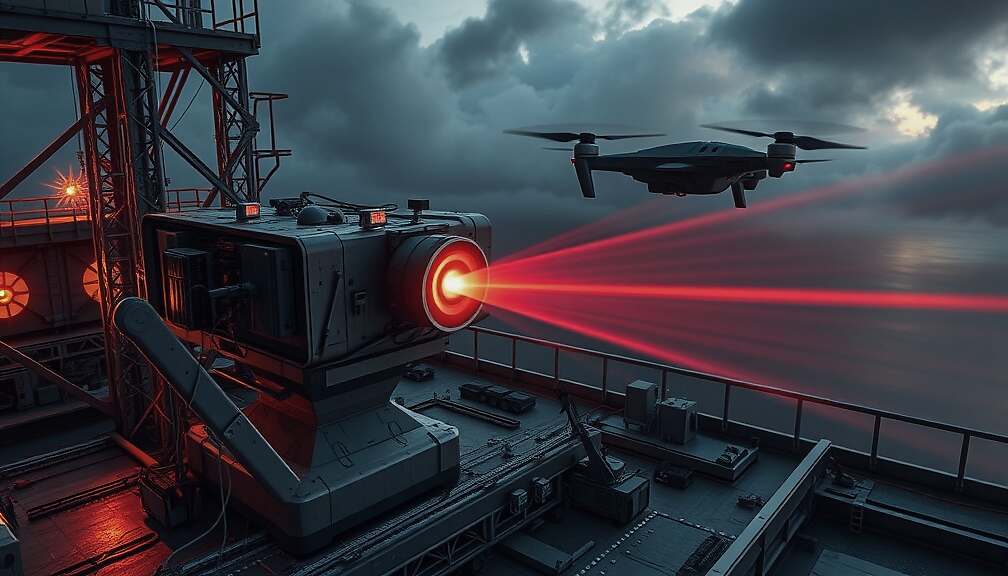
The Swabian technology conglomerate Trumpf has made concrete progress regarding its plans for a laser weapon designed for drone defense, providing specific timelines for the first time. According to Hagen Zimer, a board member of Trumpf who spoke to the Frankfurter Allgemeine Zeitung, the company aims to have a system ready by early 2027 that can be used for comparison shooting. The project has spanned three years, leaving slightly more than two years remaining, and Zimer expects a deployable product by the end of 2028. The physicist described the progress on the project as going well.
Trumpf is recognized as a leading laser specialist in Europe. Last autumn, the company announced that it was partnering with the Munich-based Funk- and Radar specialist Rohde & Schwarz to develop a defensive weapon against drones, though details were previously undisclosed. Zimer highlighted the growing threat posed primarily by swarms of reconnaissance and combat drones, which can autonomously fly and attack with the aid of artificial intelligence. “This is no longer science fiction; it is already possible today.” He added that such swarms could only be repelled in the future by laser weapons used in conjunction with other defensive measures.
The Trumpf manager for the FAZ stated that the laser weapon will serve as a highly efficient and cost-effective complementary weapon to existing systems by neutralizing drones, thus filling current gaps in defense capabilities. The anticipated acquisition costs are comparable to those of standard missile systems. However, while each rocket can cost six figures, the cost per laser shot will be less than a dollar. Zimer also addressed concerns about power consumption, stating that the demand is within reasonable limits. He claimed that to eliminate a swarm of 50 drones within two minutes, only a fraction of the power contained in a fully charged car battery is required. Currently, the most significant technical challenge remains precisely aiming the laser beam for a sufficient duration onto an incoming drone to successfully shoot it down, but Zimer feels the solution is on the horizon. He proudly asserted that Trumpf is the only major European manufacturer of laser systems capable of achieving this long-term.
Beyond military technology, the Trumpf board has called on the federal government to provide clear assurances regarding the application of laser technology in nuclear fusion. The company has already succeeded in securing commitments for magnet technology, actively pushing forward with the construction of a stellarator facility for testing. Zimer emphasized that if the high-tech agenda decides around 2035 on which technology will power fusion plants, the necessary prerequisites must be established to make that possible.
In return for this support, Zimer offered a direct guarantee to politicians: “If it were decided that a fusion facility would be built, for example, in Biblis, I would immediately raise my hand and say: Trumpf will build the lasers for it. Industry needs absolute planning certainty in such a capital-intensive environment.” Such a test plant would require about 1,000 lasers, costing between 200 and 300 million euros, for which Zimer stressed funding would be necessary.
Nuclear fusion is considered a beacon of hope for future energy needs because, unlike nuclear fission, it produces no radioactive waste. There are two competing approaches to its development: laser-based technology and magnetic resonance technology. While German startups are strong in both fields, commercial industrial use remains far off. It is not expected until the middle of the next decade that functional test plants will be available at client companies.