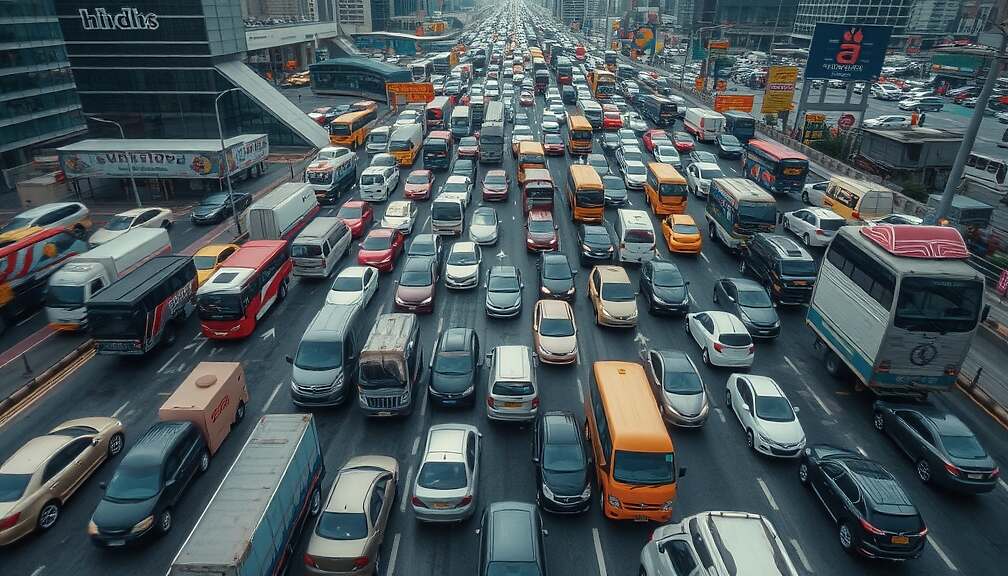
The density of cars in Germany continues to rise. According to the Federal Statistical Office (Destatis), as of the beginning of 2026, the average car density stood at 593 vehicles per 1,000 inhabitants. This represents an increase of three vehicles per 1,000 inhabitants compared to the previous year and five more than the figures recorded in 2024. This upward trend in car density has been continuous since 2008.
The increase is attributable to a renewed growth in the number of vehicles registered. The Federal Motor Transport Authority (KBA) reported that there were approximately 49.5 million cars registered in Germany as of January 1, 2026-a record number. This is an increase from the 49.3 million vehicles registered on January 1, 2025.
While car density increased compared to the previous year in all of Germany’s federal states with an area, the density actually decreased in the three city-states. Furthermore, the number of cars per capita varies significantly across the federal states. In early 2026, the highest car density was found in Saarland, with 649 vehicles per 1,000 inhabitants, followed by Rhineland-Palatinate at 644 and Bavaria at 639. Conversely, the lowest density was in Berlin, one of the city-states, at 330 vehicles per 1,000 inhabitants, followed by Bremen at 427 and Hamburg at 432. Among the states with a relatively large area, Saxony reported the lowest car density at 544 vehicles per 1,000 inhabitants. Generally, car density tends to be higher in rural areas than in urban regions, possibly due to inadequate transport infrastructure and longer commuting distances in these areas.
Mirroring the trend in car density, the total mileage driven has also increased in recent years, despite a sharp decline in 2020. Environmental-Economic Accounting data showed that in 2024, households and the economy together traveled 576.3 billion kilometers by car. Of this, 480.3 billion kilometers (83.3 percent) were driven by private households, and 96.0 billion kilometers (16.7 percent) were driven by the general economy. Compared to the total of 571.0 billion kilometers driven in 2023, this mileage saw a slight increase of 0.9 percent. However, when compared to 2020’s total of 538.4 billion kilometers, the increase was 7.0 percent. Nevertheless, the level reached in 2019, the pre-pandemic year, when a total of 639.3 billion kilometers were driven, was undercut by 9.9 percent.