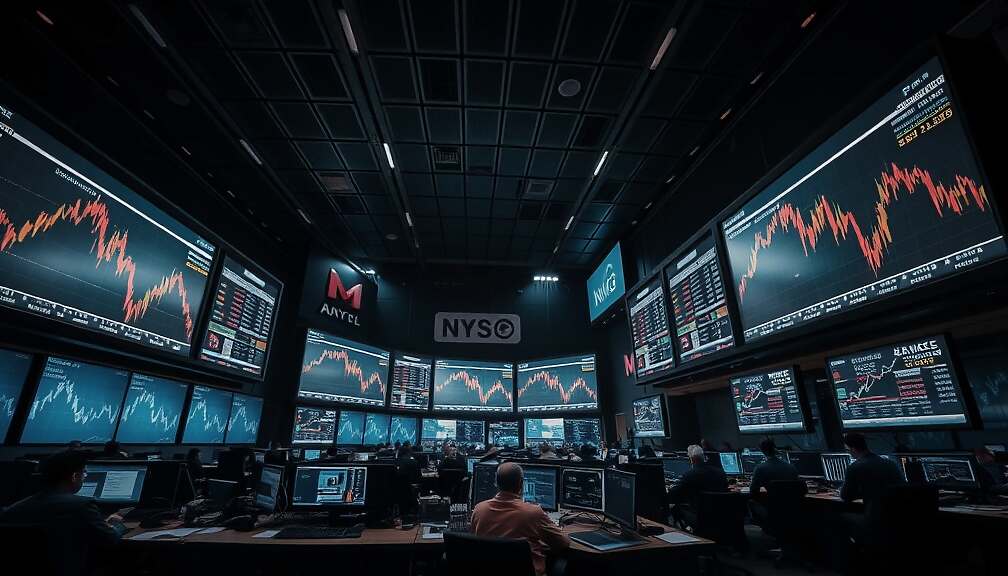
The DAX finished the week with a notable decline. At the close of trading on Xetra, the index registered 25,182 points, representing a drop of 0.8 percent compared to the previous day’s closing figure.
In terms of stock performance, Fresenius Medical Care led the list, gaining strongly by over two percent just before the market closed, followed by Beiersdorf and Zalando. Conversely, the stocks of MTU Aero Engines plummeted steeply, falling by over four percent near the end of the session, with Siemens Energy and Deutsche Telekom also recording losses.
According to Andreas Lipkow, Chief Market Analyst at CMC Markets, while the selling pressure has lessened, he noted that there is no true relief to be found. He pointed out that investors are currently waiting for new momentum from the United States, while economic prospects for Europe continue to look increasingly bleak.
Lipkow emphasized that the continuously rising oil prices are proving to be a serious strain on the market. He stated that the recently published European Purchasing Managers’ indices already demonstrate how fragile the economy has become. The main danger, he explained, lies in the delayed effects of the energy price shock. Higher transportation and production costs often take months to be fully passed on to consumers. Consequently, the secondary and tertiary ripple effects could resonate well into the coming year. Markets are currently reacting to today’s inflation data but must increasingly factor in the price increases of tomorrow. He concluded that this is where the risk of a prolonged burden on the economy and corporate profits resides.
Hesitancy is also evident on Wall Street. Lipkow observed that even convincing quarterly results are often insufficient to trigger sustained buying impulses. Recent price reactions seen in Meta and SpaceX illustrate that investors are increasingly using positive news for profit-taking. He stated that when good business results no longer translate into rewards, it is a clear sign of diminishing risk-taking appetite. Upcoming sentiment tests, including the US Purchasing Managers’ indices and the University of Michigan Consumer Confidence, are expected to reveal whether the combination of rising prices and growing economic uncertainty is already having a discernible impact in the United States.
On currency markets, the European common currency was slightly weaker on Friday afternoon. The Euro traded at $1.1199, meaning the dollar was available for 0.8929 euros.
Regarding commodities, the gold price weakened, trading at $3,997 per fine ounce on Friday afternoon, a 0.6 percent decrease. This equates to a price of 114.75 euros per gram. Meanwhile, the oil price sharply increased. At 5 PM Central European Time on Friday, a barrel of North Sea Brent crude cost $116.30, a gain of 2.8 percent over the previous trading day’s close.