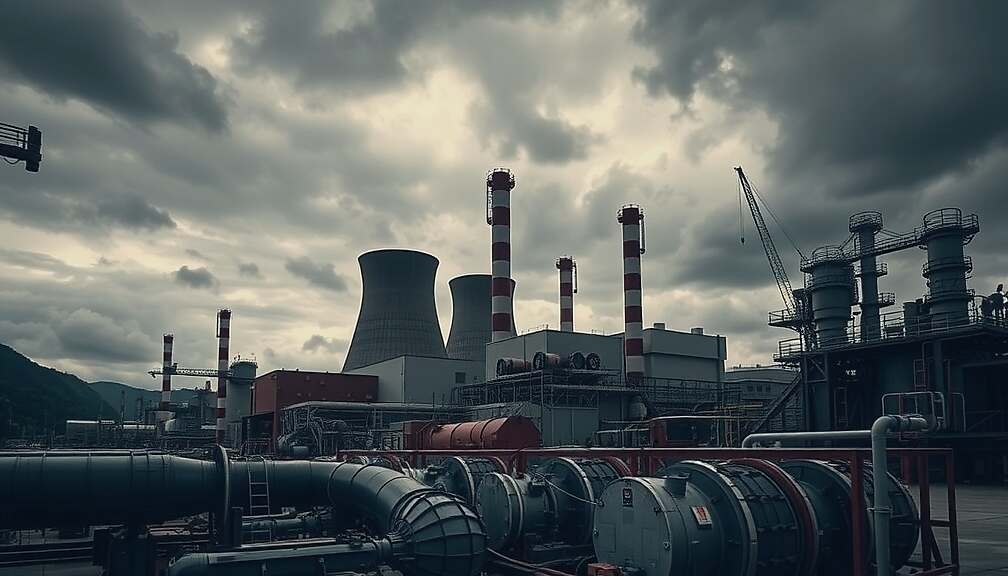
CDU politician Roderich Kiesewetter is demanding the revocation of the permit for the controversial nuclear project in Lingen, Lower Saxony, which involves the Russian state corporation Rosatom. Speaking to “Politico”, Kiesewetter asserted that the decision poses a security threat that must be reversed, stating that the approval for Lingen could barely be classified as anything other than a successful Russian influence operation or an act of immense recklessness.
While Lower Saxony’s Environment Ministry confirmed to “Politico” that it will grant the permit to Framatome’s subsidiary, Advanced Nuclear Fuels (ANF), provided certain conditions are met, the project’s scope is significant. At the Lingen site, Framatome plans to produce hexagonal fuel elements of Russian design in addition to the elements already manufactured. The Rosatom subsidiary, TVEL, is set to supply the necessary facilities, expertise, and licenses for this work.
According to Lower Saxony, the approval was based on a federal statement drafted in February, coordinated by the Federal Environment Ministry. This statement involved the Federal Chancellery and the Federal Interior Ministry and contained the security agencies’ current assessment of Russian participation, proposing specific security conditions for the project. However, “Politico” reported that previous assessments from various federal ministers, during the incumbent coalition government, had been notably more critical.
Even though the Lower Saxony Environment Ministry made the final decision regarding the Lingen project, State Environment Minister Christian Meyer (Greens) characterized the government’s acceptance of the revised security evaluation as “fundamentally wrong.” Nevertheless, he confessed to “Politico” that he is legally obligated to accept the ruling.
Kiesewetter sharply criticized the federal reassessment of the security situation. He argued that the evaluation, prepared under the Federal Environment Ministry’s guidance, was “grossly negligent in my view” and contradicted German security interests. He stressed that Russia has long used Rosatom as an “instrument of hybrid warfare” and for concrete influence operations in countries that cooperate with Rosatom or its subsidiaries. In his view, supporting the production of Russian-designed fuel elements in Germany goes against the foreign policy strategy aimed at isolating Russia internationally and curtailing its geo-economic influence instruments.
Meyer’s office had also inquired with the Federal Environment Ministry whether the approval could still be rejected based on internal or external security concerns. The response from Berlin was unequivocal: the federal ministry explained that “based on current findings regarding the risk potential and the granted conditions, no situation is discernible that would allow for a legally sound refusal of the permit.”
The Federal Environment Ministry, which is involved in the permitting process as the federal supervisory authority, distances itself from responsibility for the final decision. It stated that the state ministry is responsible for investigating and assessing the facts as the permitting authority. Although the state ministry is subject to federal oversight, it makes its decisions autonomously, unless the Federal Environment Ministry takes comprehensive decision-making authority in the matter. In practice, however, the federal ministry had been involved since 2022, reserving the right to issue the final approval-which has now been done.