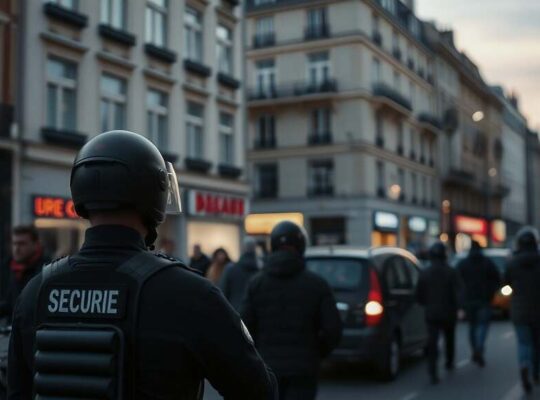
The Police Union in North Rhine-Westphalia (NRW) views developments in Islamism within the most populous federal state as dangerously accelerating, particularly following the CSD attack in Berlin. Patrick Schlüter, the state chairman of the union, told the “Rheinische Post” that NRW currently has an estimated 182 high-risk individuals, 166 of whom are considered dangerous due to religious ideology-meaning they are Islamist extremists who could be willing to go to extremes.
Law enforcement agencies have been grappling with the difficult challenge of “individual radicalization” occurring online. This manifests through social media, but also in chatrooms on gaming platforms. From a counter-terrorism perspective, this makes it significantly harder to identify potential perpetrators, especially given the limited scope of observation tools.
Schlüter also pinpointed policy as a critical area needing attention. He argued that current priorities have favored individual liberties over safety through surveillance measures. Given the current climate, he stated that this balance needs re-evaluation. While not advocating for mass surveillance, he called for a “reasonable expansion” of measures to enhance security.
Specifically, the union leader demanded greater deployment of Artificial Intelligence (AI). He explained that AI is necessary to detect when someone transitions from a merely attentive reader on social media to a participant in radical discussions. He added that human resources alone cannot handle the immense volume of data involved. Therefore, he stressed the importance of not rushing the removal of Palantir due to public pressure without having an adequate replacement ready. While the union would prefer a comparable alternative developed within the EU-and believes the necessary IT expertise exists-Schlüter warned that shutting down Palantir before a viable solution is in place would create an “extremely dangerous gap.”
Beyond technological tools and legal instruments, Schlüter emphasized the urgent need for more personnel in both the police and the Federal Office for the Protection of the Constitution (BfV). Currently, the organizations are still far from having sufficient staff. Although there is a notable increase of about 700 personnel scheduled through September-the first significant rise in over two decades-he admitted this is far from enough.
Looking ahead to upcoming major CSD events, awareness levels are understandably heightened. However, Berlin demonstrated that such incidents can occur immediately adjacent to secure event grounds. As he noted, there are limits to what can be protected, and even on the first street outside the defined event area, crowds often gather and celebrate.