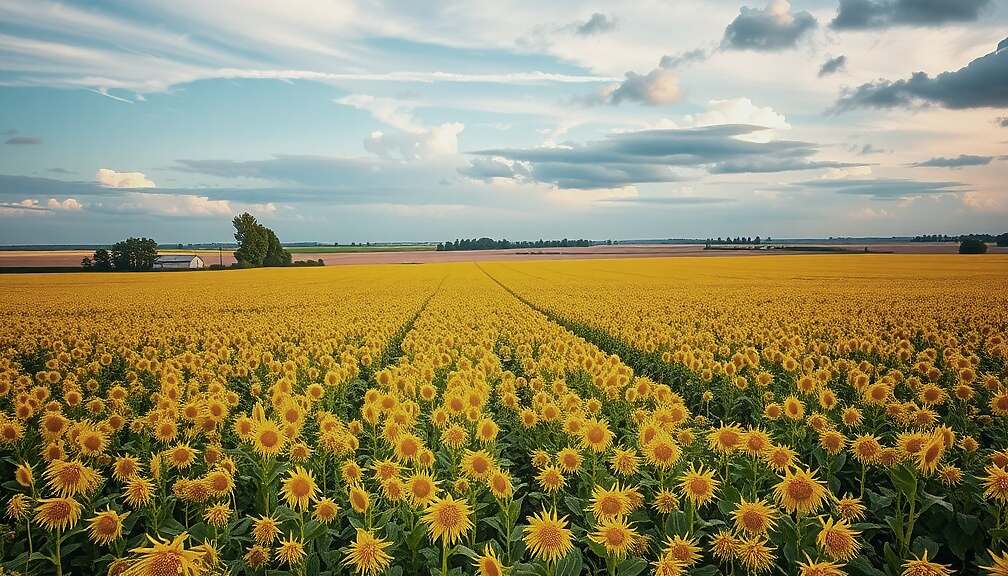
The area designated for soybean cultivation in Germany has grown significantly, increasing by 174.1 percent between 2016 and 2025. Last year, a total of 43,300 hectares were dedicated to soybean farming, with over half (52.7 percent) of this land located in Bavaria, according to statistics released by the Federal Statistical Office (Destatis) on Thursday. This is a substantial increase from just 15,800 hectares nationwide in 2016. Furthermore, the proportion of soybean cultivation relative to the total agriculturally utilized area reached 0.3 percent in 2025.
The harvest output has risen in parallel with the area increase. Destatis reports that the total quantity of soybeans harvested more than tripled between 2016 and 2025, jumping from 43,200 tons to 130,800 tons, which represents a 202.8 percent increase. In 2025, the majority of the German soybean harvest originated in Bavaria (57.3 percent), followed by Baden-Württemberg (18.0 percent) and Saxony-Anhalt (6.9 percent).
While German production has boomed, a much larger share of the country’s soybean supply comes from imports. In 2025, Germany introduced 3.4 million tons of soybeans, an increase of 8.4 percent compared to the 3.1 million tons imported in 2016. The United States was the largest supplier in 2025, providing 2.2 million tons-nearly two-thirds (64.1 percent) of the total imported volume. Other key suppliers included Brazil (16.5 percent) and Ukraine (9.0 percent).
Comparing this to the European Union (EU), the percentage growth in soybean cultivation area was less dramatic in the EU than in Germany. According to Eurostat, the EU cultivated 1.0 million hectares of soybeans in 2025, representing a good fifth (22.1 percent) more than the 831,200 hectares reported in 2016.
The total soybean harvest across the EU in 2025 was approximately 2.8 million tons, nearly ten percent higher than the 2.5 million tons recorded in 2016. However, harvest yields fluctuated in intervening years, with particularly high yields recorded in 2018 and 2024.
Within the EU, Italy emerged as the most significant soybean producer in 2025, utilizing 297,800 hectares and yielding 1.1 million tons, followed by France, which managed 150,200 hectares and harvested 391,900 tons. These two nations accounted for 44.1 percent of the EU’s total cultivated area and a substantial 53.5 percent of the total soybean harvest. Germany held a relatively small portion of the EU’s overall soybean production in 2025, contributing 4.3 percent of the cultivated area and 4.7 percent of the harvest.
Soybeans are used not only to feed livestock but also in the production of various human food items, such as tofu and soy yogurt.