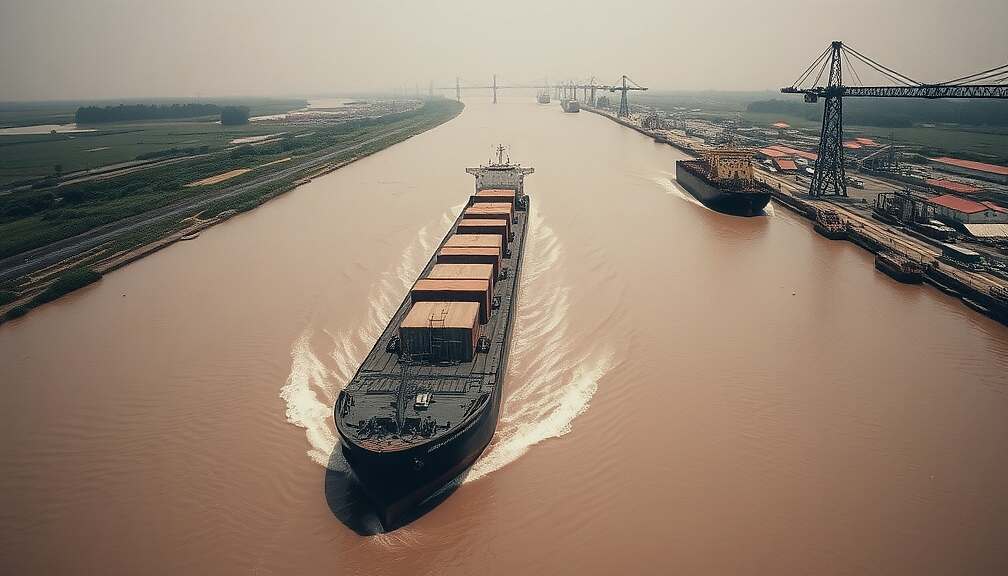
The Federal Association of German Inland Shipping (BDB) has sounded the alarm, warning that ongoing low water levels and predicted continued drops in river heights could effectively split the Rhine for economic transport.
Jens Schwanen, CEO of the BDB, informed the “Rheinische Post” that “the development of the water levels shows no good signs.” Due to a lack of rainfall, he warned that the Gau-Kaub river level, which is crucial for shipping and the economy, is projected to hit a single-digit value this week. Such low water levels would prevent commercial shipping from transporting goods in the region, and the same would apply to day trips and passenger cruises.
Schwanen explained that this effectively means the Rhine would no longer be continuously navigable, leading to a division: “There is still shipping between the ARA ports (Amsterdam, Rotterdam, Antwerp) and North Rhine-Westphalia up to about Cologne, running along the Rhine and the West German canal area,” he clarified. Additionally, maritime traffic would continue on the tributary rivers of the Neckar, Mosel, and Main, as well as the Main-Danube Canal, further south.
In response to this situation, the BDB CEO welcomed further planned crisis meetings with the Federal Ministry of Transport. Schwanen stated, “It is therefore correct that options for increasing the use of road and rail transport, coordinated by Claudia Stutz, State Secretary at the Federal Ministry of Transport, are already being debated this Monday.” He also advocated for postponing construction work on waterways. Regarding an upcoming meeting, he said that the planned construction jobs across road, rail, and waterway infrastructure would be reviewed the following Wednesday, stressing that any infrastructure restriction should ideally be avoided through the rescheduling of construction sites. Fortunately, this is already succeeding on the waterway front: The Waterways and Shipping Authority “West German Canals” has agreed to postpone the seven-week complete closure of the Wanne-Eickel lock on the Rhine-Herne Canal, as urgently requested by the BDB. This alternative route via the canal remains open and available during this critical situation.