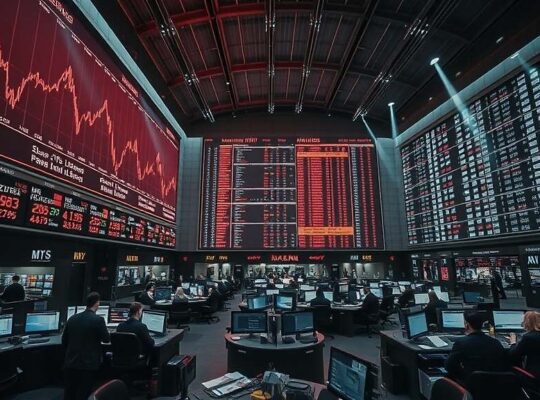
The German DAX continued its slide into negative territory on Wednesday, after starting the day weakly and remaining in the red through midday. By 12:30 PM, the leading German index was calculated at 25,645 points, representing a 1.4 percent decrease compared to the previous day’s closing level. RWE, SAP, and Eon led the stocks by rating, while Rheinmetall, Siemens, and Heidelberg Materials finished at the high end of the ranking.
Andreas Lipkow, Chief Market Analyst at CMC Markets, explained that investors in Frankfurt are highly concerned about the ongoing rise in energy prices. Specifically, the Brent crude oil grade from the North Sea has once again surpassed the 100 US dollar stress level. With crucial central bank meetings approaching, investors remain nervous.
Lipkow also noted that another major event is slowly becoming apparent to traders. Next week, on the large expiration date at the derivatives exchanges, the US alone is expected to handle an options volume of around six trillion US dollars. This accounts for approximately 35 percent of all outstanding options contracts and continues a record streak dating back to June. Historically, Lipkow observes that the average nominal volume in September typically falls between four and five trillion US dollars.
The analyst added that investors are staying cautious, conceding ground to sellers. Lipkow stated that the renewed escalation in the Middle East and the resulting uncertainties surrounding the Strait of Hormuz are currently inhibiting a comfortable investment environment. Because of this, it is not surprising that the DAX declined, even despite potentially more favorable economic forecasts for Germany.
The European common currency remained largely unchanged by midday on Wednesday; the euro was trading at $1.1627, while the dollar was available for 0.8601 euros. Meanwhile, oil prices rose sharply. At around noon German time, a barrel of North Sea Brent crude cost $100.60, marking a 2.7 percent increase over the previous day’s close.