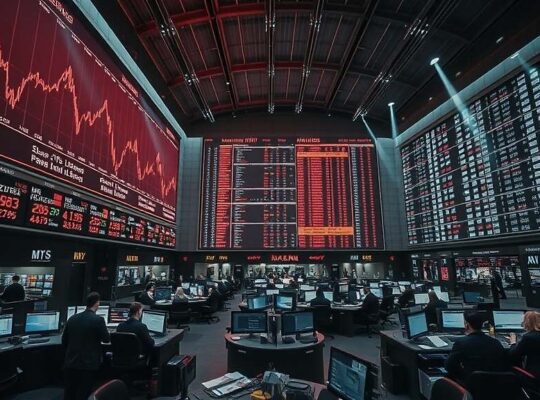
Mid-week trading saw the DAX decline significantly on Wednesday. At the close of Xetra trading, the index stood at 25,576 points, reflecting a 1.7% drop compared to the previous day’s closing figure.
Andreas Lipkow, Chief Market Analyst at CMC Markets, attributed the downturn to escalating tensions in the Middle East, which pushed oil prices over the 100-dollar mark and increased nervousness across the stock exchange. He highlighted that investors heavily sold off cyclical stocks, sinking the DAX deeply into losses. Lipkow noted that the 26,000-point milestone appears further away than ever before, stating that the immediate priority is regaining stability. The price of the North Sea crude, Brent, continues to rise relentlessly without showing any signs of weakness.
The uncertainty surrounding the Middle East, particularly regarding the Strait of Hormuz, is currently not conducive to positive investment, prompting many investors to stay on the sidelines and allow sellers to dictate the market pace. This environment explains why the DAX registered a retreat, despite potentially more positive economic outlooks for Germany.
Looking ahead, there is a high likelihood of significant warnings from the President of the European Central Bank, Christine Lagarde, on Thursday regarding future interest rate policy, which could generate further selling pressure. Currently, the market is pricing in two rate hikes this year. However, if the ECB identifies broader inflationary risks and seeks to combat them proactively, the upward trend in key interest rates could extend beyond the end of the year. This potential shift is supported by the Euro’s performance, which is increasing against the US dollar.
Furthermore, a major financial event is gradually drawing closer to market attention. Next week’s major options expiration date on futures markets in the US is expected to involve a volume of around six trillion US dollars. This figure accounts for roughly 35% of all outstanding options contracts, continuing the record streak started in June. Historically, the average nominal volume for September falls between four and five trillion US dollars.
In other market movements, the gold price saw a substantial increase, climbing by 1.1% in the afternoon to $4,404 per fine ounce, translating to 121.81 Euros per gram. Heavy crude oil also posted strong gains, with a barrel of North Sea Brent trading at $101.40 around 5 PM German time, marking a 3.5% increase over the previous day’s close.
Meanwhile, the European common currency was slightly weaker on Wednesday afternoon, with one Euro fetching 1.1625 US dollars, meaning the dollar was trading for 0.8602 Euros.