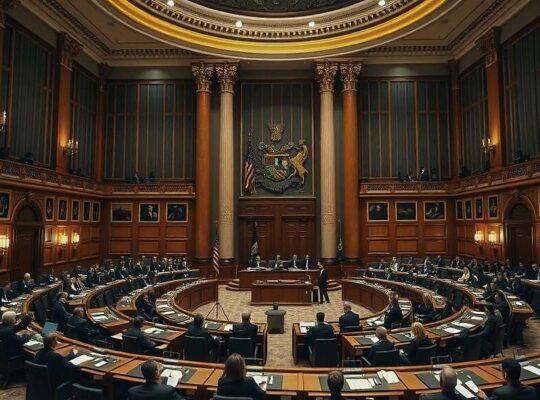
The results of the elections in Saxony-Anhalt and the success of the AfD are viewed by Belgian historian David Van Reybrouck as a critical impetus to examine the procedures of democracy more closely. Speaking to the weekly magazine “Die Zeit”, Van Reybrouck stated that this outcome reflects what happens when there is insufficient investment in the resilience and renewal of democratic systems. He is currently involved in experiments in Belgium and elsewhere that are testing new forms of democratic participation.
The historian contends that a significant problem is the tendency to reduce democracy solely to elections. He points out that contemporary representative democracy is merely one mode among many, recalling that systems like lotteries played an important role in ancient Athens.
Stemming from this perspective, Van Reybrouck contributed to the development of the so-called East Belgium Model. This model is now regarded by the OECD as a gold standard for institutionalized deliberative democracies. It cleverly integrates the elected parliament with a council composed of randomly selected citizens, as well as short-term citizen assemblies whose members are also drawn by lot. The German-speaking part of Belgium introduced this procedure over a decade ago, and cities including Brussels, Paris, and Aachen have since adopted it.
Van Reybrouck suggests that the logical next step would be to initiate the East Belgium Model at a national level within a small European nation. He specifically noted that this could potentially be a German state (“Bundesland”).