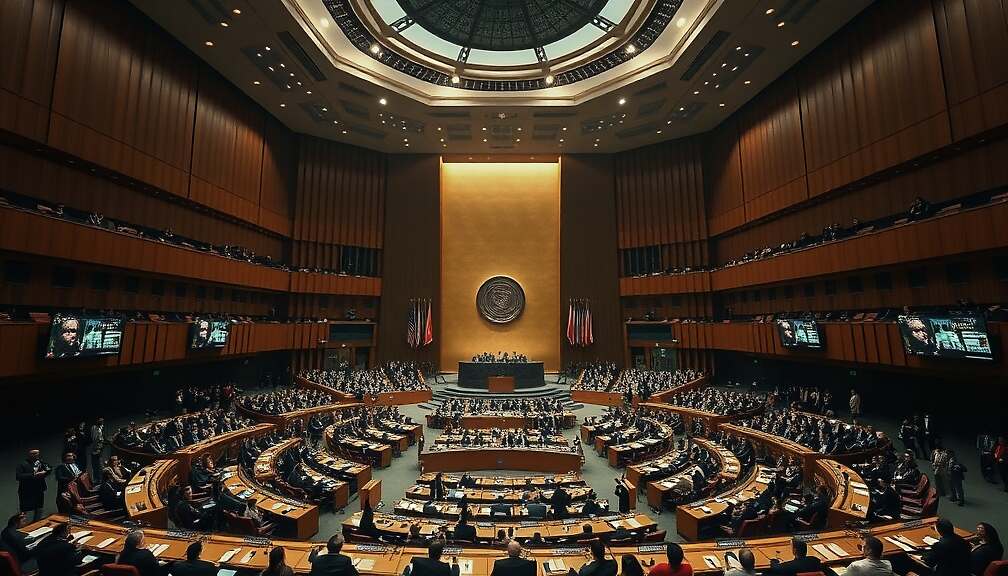
German Foreign Minister Johann Wadephul (CDU) has called for the United Nations to take on a stronger role in ending global crises. Ahead of his travel to New York to attend the 81st UN General Assembly, the CDU politician stated that the United Nations was founded over 80 years ago to provide humanity with a central mechanism for a peaceful international order following the horrors of the Second World War. He expressed concern that the prospect of sustainable, conflict-free coexistence has been replaced by a cycle of continuous escalation, a development he sees as something the world cannot and should not grow accustomed to.
Wadephul emphasized that there is a collective duty to mobilize shared efforts to turn the tide. He noted that the numerous discussions taking place that week offer a rare opportunity for this shift. He affirmed that Germany will contribute its part, working to overcome the stifling communication gaps between conflict parties, not only in Europe but also in the Middle East. He insisted that when the global community convenes in New York, the agenda cannot merely be a “pure status assessment” of all the world’s crises, conflicts, and wars; instead, all politically responsible parties must be prepared to seriously pursue even the smallest steps toward resolution.
Furthermore, he stressed the necessity for the international community to collectively assume greater responsibility for maritime security. He highlighted the situation in the Strait of Hormuz and the Bab el-Mandab, where Iran and its militias have held the lifelines of free trade hostage for months. He warned that shortages of energy supplies, fertilizers, and relief goods are causing massive disruptions, making these essential commodities either unaffordable or unable to reach areas of critical need. The consequences of this insecurity are felt in Germany and Europe, but they are even more dramatic across the countries of the Global South, where rising prices and crop failures pose existential threats.
Ultimately, the minister argued that a stable international order requires the United Nations to function as more than just an administrator of crises and conflicts; it must lay the necessary groundwork for lasting solutions. He believes the UN must act as an operational arm of the international community, providing mediation, such as in the Sudan conflict, assisting in unblocking trade routes, and actively tackling human rights violations. He also asserted that the UN must take greater responsibility for contemporary challenges, including finding common ground in dealing with the opportunities and challenges presented by artificial intelligence.