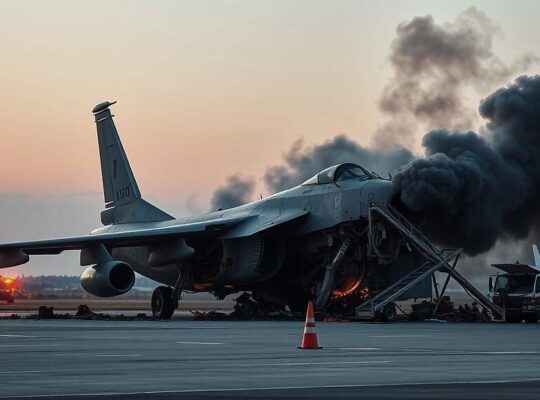
About seven weeks after the spectacular incident involving a Boeing 787-9 at Munich Airport, the Federal Bureau of Aircraft Accident Investigation (BFU) released an interim report.
The Vietnam Airlines flight was scheduled to depart for Hanoi, Vietnam, on August 15th. The aircraft carried 271 passengers, 12 cabin crew members, and four pilots. At 1:56 PM Munich time, the aircraft taxied onto Runway 26L.
However, the takeoff did not proceed as planned. Instead of lifting off at the scheduled end of the runway, the aircraft took off into the grass area. Viral videos captured the scene, showing the tail and the main landing gear wheels colliding with parts of the approach lighting. A total of 20 lights were damaged, and the aircraft sustained significant fuselage damage.
The crew made the decision to abort the takeoff. After several flights where ground staff could inspect the landing gear, the aircraft finally landed on Runway 26R. During the landing, four tires on the left main gear were damaged. All occupants remained unharmed.
The new findings reveal that, according to the flight data recorders, the pilots began braking several times even before the aircraft lifted off during the takeoff roll. The investigation shows that the pilots engaged the brakes about one minute before rotation height. Visible tire tracks of both main gear sets were seen on the runway at a runway junction.
Subsequently, there were further braking maneuvers. For about 18 seconds, the aircraft’s speed dropped to approximately 168 knots (about 311 km/h), punctuated by brief fluctuations. The actual rotation-the raising of the nose to initiate takeoff-did not occur until the runway threshold, the very end of the paved surface. The aircraft then lifted off into the surrounding grass area. The tire tracks extended past the threshold and into the designated clearway (a safety area behind the runway), ending approximately 240 meters into the grass.
Crucially, the V1 speed-the decision speed after which a takeoff cannot be safely aborted-was only reached “after” the lift-off and the collision with the lights. This means that by the time the crew could have potentially aborted the flight, the aircraft was already past the end of the runway.
Shortly after the lift-off, at only 15 feet (about 4.5 meters) in altitude, the plane’s automatic stall protection system activated. The leading-edge slats deployed fully and automatically to prevent a stall. The aircraft’s angle of attack had already climbed to 14 degrees at this point, a value close to the critical limit. The crew then activated the Take-Off/Go-Around mode, a standard procedure for such situations.
After taking off, the aircraft climbed to 7,000 feet, at which point the crew transmitted a “pan pan” distress call. They requested radar guidance so they could dump fuel; a total of 62 tons of kerosene was eventually jettisoned to reduce the landing weight. The crew anticipated landing with flat tires.
Following two passes where the landing gear was kept extended for ground personnel inspection, the aircraft finally landed at 3:56 PM on Runway 26R. The four tires on the left main gear were damaged. Passengers evacuated using mobile stairs, and no one was injured.
The report also details the four pilots onboard. The 64-year-old Captain, a highly experienced pilot with over 27,000 flight hours-nearly 7,800 on the Boeing 787 model-was the pilot flying during the takeoff. The 40-year-old Co-pilot managed the instruments. Interestingly, another 55-year-old pilot took over controls later in the flight and handled the landing. A 31-year-old pilot was the fourth member in the cockpit but remained passive according to the interim report.
The investigation is not yet complete. The BFU has secured several electronic control units from the braking system and is currently examining them in detail.