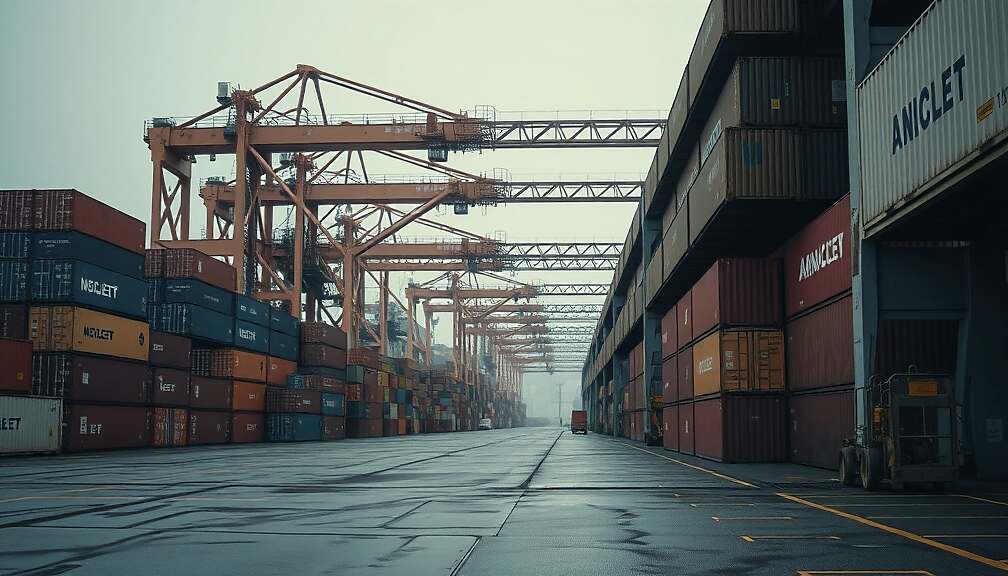
The trade and exchanges between Germany and Russia have diminished significantly in many ways since Russia began its invasion of Ukraine in February 2022. According to statistics released by Destatis (the Federal Statistical Office) on Wednesday, in the first half of 2026, Germany imported 96.4 percent fewer goods from the Russian Federation compared to the first half of 2021.
During the first half of 2026, goods imported from Russia amounted to just over half a billion euros. This is a sharp drop from the 15 billion euros imported from Russia in the first half of 2021. Exports to Russia have also decreased substantially, though the decline was less steep than imports. Germany exported goods worth 3.4 billion euros to Russia in the past six months. This figure contrasts sharply with the 12.7 billion euros exported in the same period of 2021.
The European Union has implemented numerous sanctions limiting trade with Russia since the invasion. These 21 packages of EU sanctions include import bans on certain commodities (such as energy sources) and export restrictions, particularly on goods related to industry or military applications. Furthermore, the sanctions have restricted Russia’s access to capital and financial markets, excluded the country from the SWIFT banking system, and imposed entry and flight bans on Russians as well as against the “shadow fleet” of Russian vessels.
The relatively modest total import value of just over half a billion euros from Russia in the first half of 2026 was mainly composed of foodstuffs and feed (206.1 million euros, or 38.7 percent), metals (168.3 million euros, or 31.6 percent), and chemical products (95.9 million euros, or 18.0 percent). In the first half of 2021, crude oil and natural gas had been by far the most imported goods from Russia, valued at 9.2 billion euros and accounting for 61.5 percent of the imports. Other important commodities before the war included metals (13.5 percent) and coke and mineral oil products (7.4 percent).
Regarding exports to Russia, the total value of 3.4 billion euros in the first half of 2026 was largely comprised of pharmaceutical products (1.5 billion euros or 42.4 percent). This was followed by machinery (11.1 percent) and foodstuffs and feed (10.5 percent). Before the war, in the first half of 2021, machinery made up nearly a quarter of all German exports to Russia (23.4 percent or 3.0 billion euros), followed by cars and car parts (17.9 percent) and chemicals (11.3 percent).
The diminishing ties between the two nations are not limited to foreign trade; economic connections controlled from abroad have also shrunk. In 2024, only 76, or 0.2 percent, of Germany’s total nearly 42,400 foreign-controlled companies were under the ownership of a parent company based in Russia. These Russian-controlled entities generated 8.4 billion euros in revenue, which represented 0.4 percent of the total revenue generated by foreign-controlled companies in Germany. This is a significant decrease from 2021, when 229 Russian-controlled companies represented 0.7 percent of all such companies, generating nearly 25.4 billion euros or 1.3 percent of total revenue.
The presence of German companies in Russia has also decreased. According to the Bundesbank, in 2024, 290, or 0.9 percent, of the nearly 32,100 foreign companies controlled by German investors were operating in Russia. These companies generated an annual revenue of approximately 13 billion euros, or 0.4 percent of the worldwide revenue achieved by German-controlled foreign entities. In 2021, 481 companies controlled by Germany in Russia represented 1.5 percent of all foreign companies controlled by German investors, generating approximately 38 billion euros or 1.4 percent of their global revenue.
The decline in relations is also observable in air travel. Due to the operating direct flight ban, the number of passengers departing from or arriving at German major airports with direct connections to Russia approached zero in the first half of 2026. For comparison, before the pandemic travel restrictions, about one million passengers arrived from Russia or departed for Russia during the first half of 2019. Although a small number of passengers-around 39,900-left German major airports with their final destination in Russia in the first half of 2026, these trips involved transiting through third countries like Turkey, avoiding the direct flight ban. This figure represents a reduction of 95.9 percent compared to the 978,300 passengers in the first half of 2019, predating pandemic restrictions.
The migration pattern of Russian citizens between Germany and Russia has reversed since the Russian invasion of Ukraine in Spring 2022. In the first half of 2026, more Russian nationals left Germany (about 4,400) than arrived (about 3,800). At the start of the invasion in the first half of 2022, arrivals outweighed departures significantly (12,700 arrivals versus 3,400 departures). Even in 2021, before the invasion, when travel was still constrained by the pandemic, arrivals (about 5,300) exceeded departures (just under 3,700).
The decreased cultural and educational exchange is also evident in German universities. In the 2025 academic year, 1,700 Russian students began studies in Germany, which is 40 percent fewer than the 2,900 students in 2021. When compared to the pre-Covid level in 2019, which saw 3,100 Russian international students, the decline is even more pronounced at 45 percent. Furthermore, compared to the peak in 2014 (3,500 students), the number has more than halved, showing a drop of 52 percent.