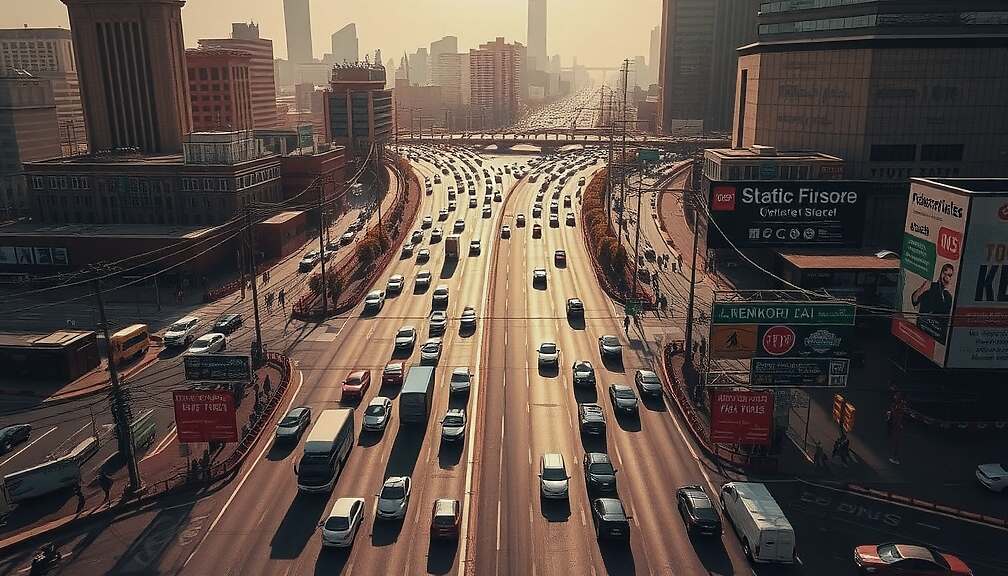
In response to recurring heatwaves and record temperatures, the Municipal Council is demanding a fundamental rethink of traffic planning and urgently requesting more funds for heat protection. According to Städtetag President Burkhard Jung, “Fewer parking spaces and roads will be unavoidable in the future if we want to cope with the effects of climate change caused by humans,” he told the “Neue Osnabrücker Zeitung.” The SPD politician emphasized that trees are a blessing for any city, stating that when trees are planted or water reservoirs are established, other infrastructure must give way.
Jung argued that six-lane roads can no longer be the solution in urban areas. To make cities more resilient, traffic flows must be redefined. This requires increasing incentives for residential parking, promoting carsharing and job bikes, and massively strengthening public local transport. Citing successful models in cities like Copenhagen, Amsterdam, and Oslo, Jung explained these conceptual shifts are necessary. He also noted that given the low river levels, he fears this is merely the beginning of future challenges that municipal authorities must address.
The president reaffirmed his support for incorporating climate adaptation into the Basic Law. He explained that doing so would transform the issue into a shared responsibility for the federal government, states, and municipalities, thereby ensuring that adequate funding is allocated. Currently, the financial capacity of local governments is insufficient to invest properly in adaptation measures.
On the financial front, Jung warned of growing discontent within local administration due to immense financial troubles plaguing the municipalities. He referenced the agricultural protests, noting that many colleagues are considering more drastic actions, such as driving fire trucks to Berlin. “I hope that doesn’t come to pass, but it looks bleak,” he commented. Because many councils lack the capacity to act, he stressed that serious relief must be delivered in the fall, otherwise, he has deep concerns about the state of democracy.
To alleviate the financial burden, Jung calls for immediate aid. He suggested that the federal government could increase the share of turnover tax allocated to local governments. Furthermore, he protested that while municipalities perform a quarter of all state services, they only receive one-seventh of the tax revenue. He also proposed restructuring the division of responsibilities across the state. Services such as child benefits, housing allowances, passport issuance, and vehicle registrations could be centrally managed by Berlin to reduce the administrative load on local councils.
For funding this relief, the Municipal Council is asking the federal government to establish a new special fund for municipalities. Referring to the previous special fund for infrastructure and defense, Jung stated that current measures are not sufficient to alleviate the severe situation facing cities. Nevertheless, he deemed this action absolutely necessary for easing municipal finances.
The core of the appeal is the poor financial health of these cities. Due to a total deficit exceeding 30 billion euros annually, many municipalities simply lack the financial maneuvering room to conduct necessary investments. “I have been in office for 21 years and have experienced many highs and lows. But a financial situation this dramatic has never existed in the Federal Republic,” Jung warned.
The SPD politician criticized the government’s financial planning thus far. He concluded that despite protests and numerous high-level meetings with seemingly understanding responses, little is actually happening. He noted that the frayed nerves of many local workers lead them to contemplate whether and how they can mount resistance.