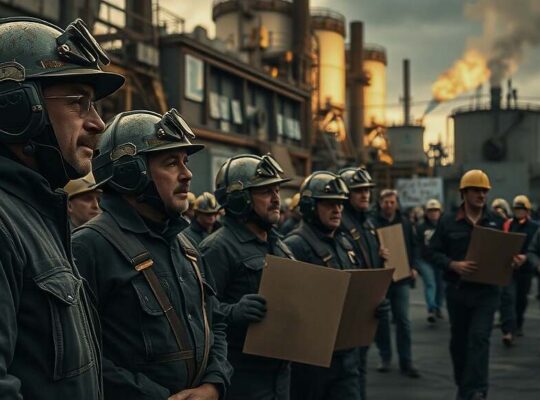
The head of the Bavarian Metal Employers has urged the IG Metall union to moderate its demands following the commencement of warning strikes across the metal and electrical industries. Stating that the union should not overdo things, Bertram Brossardt told the Süddeutsche Zeitung that the current strike actions are wholly inappropriate given the prevailing circumstances.
The friction stems from a stalled collective bargaining round affecting 3.7 million employees in Germany’s most vital industrial sector, a negotiation taking place amid a profound economic crisis affecting major manufacturers, including the automobile industry. The employers recently made an offer of a 2.3% pay increase (comprising a 1.3% wage increase and a 1.0% special payment) over a 26-month contract period. This proposal was rejected by IG Metall, which subsequently called for strikes throughout the coming week.
Brossardt publicly detailed the employers’ vision for achieving necessary cost reductions. His proposal suggests that businesses facing a crisis should not be obligated to pay their employees if their revenue margin drops below 2.3%. Furthermore, under this model, companies would not have to implement either the proposed wage increase or the supplementary payment.
He argued that this is a reasonable request given that workers in this sector already earn well compared to employees in other industries, and that workers would ultimately benefit if they retain their livelihoods. Another avenue for reducing company costs, Brossardt suggested, is increasing working hours, such as moving from the contractual 35-hour week to a 38-hour week.
Brossardt also sharply criticized the high rates of staff sick leave in many companies. The employers have initiated a discussion with the union on this topic. He noted that when looking at companies operating across Europe, the data suggests that the population in Germany is sicker than those elsewhere, though he declined to offer a definitive assessment. He stated that the goal is to work collaboratively with the union to permanently lower this high, internationally divergent sick leave rate.
In response to the IG Metall’s demand that employees at financially strong companies should automatically participate in these profits, the chief executive of the Bavarian Metal Employers turned the request down. He pointed out that only about 20% of companies are truly doing well-industries required to absorb disproportionately high wage rises in the past. He explained that these businesses could not afford extra payments currently, and forcing them to do so would risk them walking away from the collective agreement.
Negotiations between the union and the employers are scheduled to continue next week. IG Metall, meanwhile, continues to insist on demands that include a 5% increase in wages over a targeted 12-month contract period.