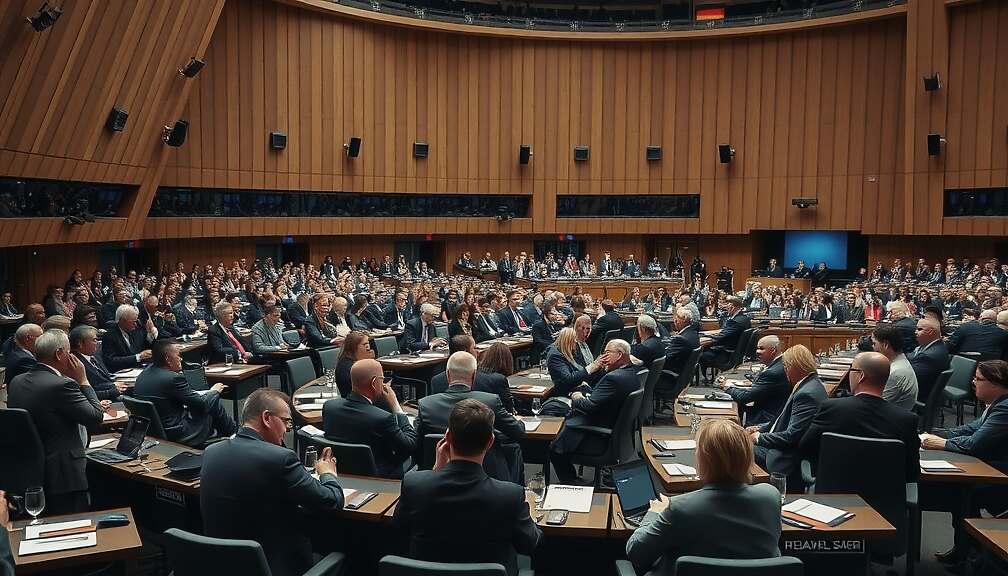
The FDP continued its federal party convention in Berlin on Sunday morning. The second and final day of the meeting will focus on further elections for the party’s presidency and federal board, alongside a crucial debate regarding the federal board’s guiding proposal. Titled “New Start for Germany” the proposal demands a decisive change for the country, asserting that the need for reform has perhaps never been so “obvious and comprehensive”. The document contends that even past periods-such as the unemployment crisis at the turn of the millennium or the reunification of East and West Germany in the 1990s-were politically challenging, but today, all problems are interconnected. The issues identified include political and economic dependence on “unpredictable partners” military and hybrid threats, political polarization, inadequate state capacity, and economic stagnation.
The FDP’s central plank in the proposal is a compact government focused on core tasks: security, the rule of law, education, and infrastructure. Specifically, the party calls for a “general revision” of existing bureaucracy and aims to end the “over-fulfillment” of EU directives. Furthermore, it proposes elevating the National Code of Norms Supervisory Council to a “genuine control body”. Other reforms include consolidating administrative procedures across federal and state boundaries and improving data protection.
Energy policy is another major focus, which should be structured in a “market-based and technology-neutral” manner. The FDP advocates significantly expanding the energy supply and utilizing the European emissions trading system as the main instrument for clean electricity generation. It also seeks to create a diverse energy mix that incorporates renewables, nuclear power and fusion, as well as gas and coal with CO2 capture.
The newly elected FDP chairman, Wolfgang Kubicki, will present the guiding proposal around noon, after which the debate will commence. The party hopes to center the discussion on these policy issues after the personal debates held the day before. However, the leadership elections highlighted deep internal divisions within the party. Kubicki secured his position with just 59 percent of the vote against his unexpected challenger, Marie-Agnes Strack-Zimmermann. Similarly, his new general secretary, Martin Hagen, received only slightly more than 59 percent, representing one of the worst results in the party’s history.
The ambitions of this new leadership are to successfully guide the FDP back into the Bundestag and prevent further defeats in upcoming state elections, with particular focus on the elections in Schleswig-Holstein and North Rhine-Westphalia set for April 2027.