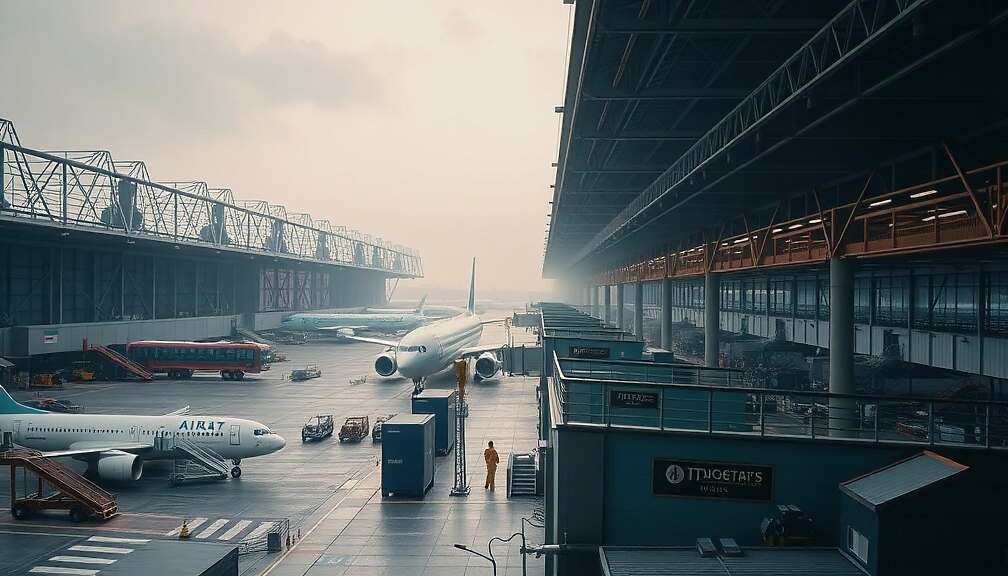
German air transport is experiencing a stagnation never seen since the end of the coronavirus pandemic. According to research conducted by the Federal Association of German Airlines (BDF), published by the “Neue Osnabrücker Zeitung” (NOZ), the country trails significantly behind the rest of Europe in industry development.
The data shows a stark contrast: in the first half of 2026, the available seat capacity for flights to and from Germany stood at only 87 percent of the pre-pandemic level recorded in the first half of 2019. Meanwhile, European nations without Germany managed to recover to an average of 113 percent of their crisis-era capacity. This represents a 26 percentage point gap compared to Germany, a distance much larger than the 18 percentage points recorded in the first half of 2023.
While some countries are experiencing substantial growth-such as Poland at 146 percent, Greece at 143 percent, and Portugal at 125 percent-Germany, alongside Finland (86 percent) and Sweden (77 percent), remains at the bottom of the continental rankings.
The BDF estimates that this lack of growth has resulted in measurable economic hardship. The estimated loss of value creation, calculated for the years 2023 through 2025 on an inflation-adjusted basis, amounts to approximately 40 billion euros. This damage stems from decreased business for suppliers, including catering companies and fuel providers, as well as reduced revenue for hotels, gastronomic establishments, and retailers due to fewer tourists and business travelers.
In response to these findings, Christoph Ploß, the government coordinator for maritime economy and tourism (CDU), called for immediate action across the political spectrum. Ploß told the NOZ that “the figures show that we all must do everything possible to ensure there are more flights to and from Germany.” He criticized the high operational costs of German airports compared to international standards. Although the federal government recently reduced the air traffic tax as of July 1st, Ploß stressed that other fixed costs, such as airport fees and expenses related to security and infrastructure, must also decrease. Warning that further flight withdrawals by other airlines could occur, and that the remaining flights would become significantly more expensive for both tourists and business travelers, Ploß concluded that the “hard-working people’s well-deserved holidays must not become unaffordable.”