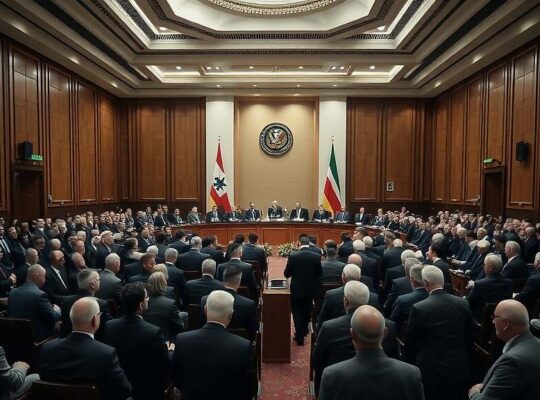
Municipalities are strongly urging the federal and state summit this Thursday to approve decisions involving billions in savings within the social sector. André Berghegger, CEO of the German Cities and Municipalities Association (DStGB), told the “Neue Osnabrücker Zeitung” that suggestions from local government bodies have been on the table for months, and the time for a decision has arrived, emphasizing that the measures must go beyond mere millions.
Berghegger clarified that the push is not for cuts, but rather for a smarter use of limited resources, asserting that the social state must help those in need. He focused on optimizing services, such as student support for children with disabilities. Currently, the legal framework requires a dedicated support person for every student, sometimes resulting in classes having five or six attendants alongside the teacher. According to the DStGB chief, this arrangement benefits no one but costs an enormous amount of money. He proposed that a shared support model would suffice in many cases, a pooling solution that could also be applied when integrating adults. Such solutions, he added, require broad consensus from both the federal and state governments, as the current tendency toward excessive attention to individual cases has led to overlooking the bigger picture.
The ministers-presidents of the states are scheduled to meet with Chancellor Friedrich Merz (CDU) on Thursday afternoon, with discussions on alleviating the financial crisis facing local communities at the core of the agenda.
Berghegger justified the urgent appeal by pointing out that social spending has risen sharply in double digits year after year. He warned that if nothing changes, municipalities face a yearly shortfall of 30 billion euros, which will increasingly make securing loans difficult and would drive up interest costs. His official proposal is to reduce social expenditure by a third, suggesting that the costs should be split evenly among the federal government, the states, and the municipalities. He argued that only then could deficits finally be addressed, which would require a fundamental rethink from legislators-meaning any new benefits would automatically incur costs for the Bund and the Länder, and any savings would benefit them financially as well.
In addition to savings in the social domain, Berghegger stated that the federal-state summit must also finalize a second policy shift. He demands a resolution on what is known as “Konkretness” (cost reimbursement). When services are authorized, the costs must be reimbursed to the municipalities. Negotiations regarding this issue have been ongoing for months, and he insists that a definitive decision must be made before the summer break to provide planning certainty.