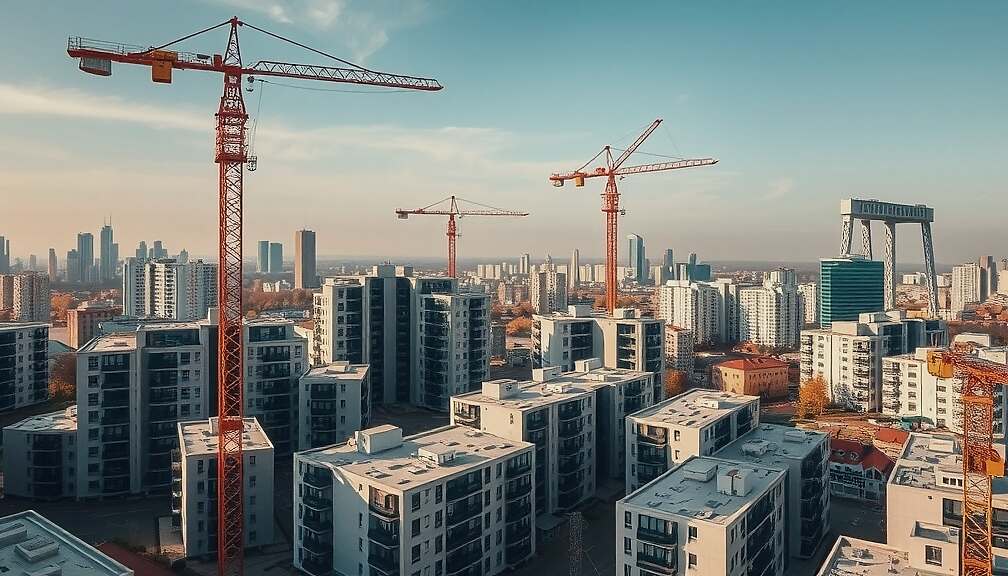
In July 2026, a total of 22,500 housing units were approved for construction in Germany. According to the Federal Statistical Office (Destatis), this represents an increase of 1.9 percent, or 400 permits, compared to July 2025. Specifically, the number of new buildings approved rose by 0.8 percent, adding 100 units to reach 18,400. Meanwhile, the count of apartments resulting from the renovation of existing structures saw a notable jump of 7.0 percent, adding 300 units to reach 4,100 compared to the previous year. It is worth noting that building permit statistics sometimes reflect approvals submitted later by local authorities, rather than the month they were initially issued.
Looking at the period from January to July 2026, building approvals for 148,800 housing units-in both new and existing buildings-were issued across Germany. This marks an increase of 12.9 percent, or 17,000 units, compared to the same period in 2025.
In terms of entirely new residential constructions, 121,200 units were approved between January and July 2026. This is 13.5 percent more than the corresponding period last year. The statistics show variations by building type: Single-family homes achieved a 9.7 percent rise (+2,500), reaching 27,900 permits. Two-family houses saw an even stronger increase of 25.0 percent (+1,800), totaling 8,900 approvals. Multi-family houses, which represent the largest category by volume, secured 79,700 new residential permits-a growth of 15.1 percent (+10,500) compared to 2025. Conversely, the permits for dormitories decreased by 6.2 percent, falling to 4,700 units (-300).
Additionally, 2,700 units (+25.0 percent; +500) were approved for new non-residential buildings, such as caretaker apartments in schools or commercial-to-residential conversions in city centers.
Finally, between January and July 2026, a total of 24,900 permits were approved for renovation projects across both residential and non-residential properties. This signifies an 8.9 percent rise, or 2,000 more units, compared to the same timeframe in 2025, according to the Federal Office.