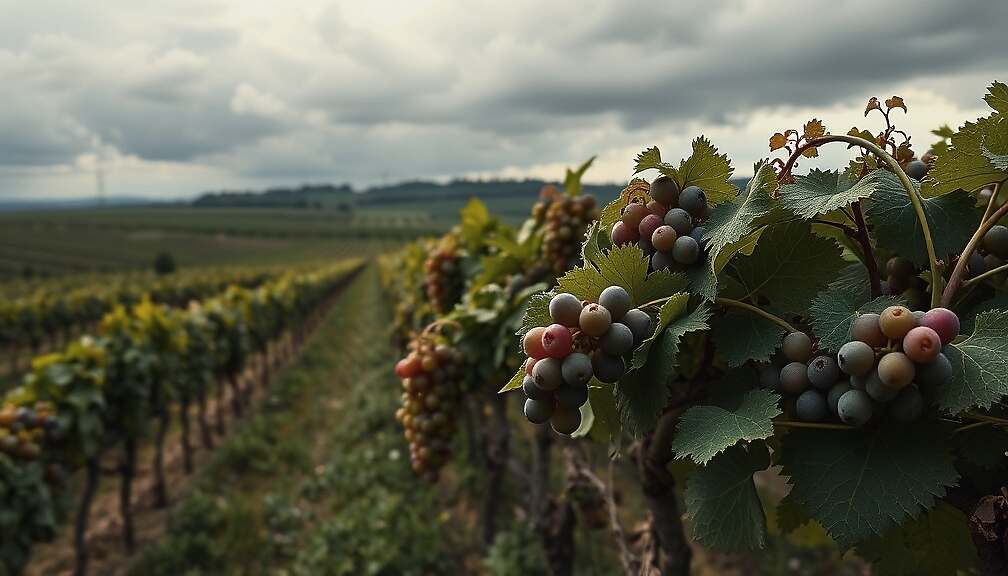
Wine producers in Germany anticipate a harvest in 2026 that will be 0.3 million hectoliters, or four percent, lower than the average recorded between 2020 and 2025. According to the Federal Statistical Office (Destatis), based on the second estimate released on September 20, 2026, the total expected volume of wine must will be 8.0 million hectoliters. This represents a five percent increase compared to the previous year, which yielded 7.7 million hectoliters.
These harvest estimations are derived from voluntary reports submitted by producers regarding their expected must yields. However, it should be noted that these expected yields remain subject to change depending on subsequent weather conditions, specific localized events, plant diseases, and pests throughout the growing season.
The current 2026 vintage has been characterized by drought and high temperatures. The water shortage has led to grapes being smaller, which naturally impacts the overall yield. On the other hand, this increased concentration of ingredients is expected to contribute to a high-quality wine year. So far, large-scale crop damage has been minimal, save for localized instances of hailstorms.
As in previous years, the largest wine-producing regions-Rheinhessen (2.4 million hectoliters) and Pfalz (2.1 million hectoliters)-account for over half (56 percent) of the expected German wine harvest. A further quarter (24 percent) is allocated to the growing areas of Baden (1.2 million hectoliters) and Württemberg (772,000 hectoliters).
Regional changes show varying trends compared to the preceding year. Seven growing regions are projected to see increases in harvest volume. Significant absolute increases were seen in Pfalz (+214,000 hectoliters or +11 percent), Baden (+171,000 hectoliters or +17 percent), and Rheinhessen (+141,000 hectoliters or +6 percent). It is important to contextualize these increases, however, as harvests in Rheinhessen and Pfalz saw sharp declines compared to 2024 in 2025. Other areas showing year-over-year growth include Württemberg (32,000 hectoliters or +4 percent), Rheingau (+34,000 hectoliters or +20 percent), Hessische Bergstraße (+7,000 hectoliters or +26 percent), and Mittelrhein (+2,000 hectoliters or +8 percent).
Conversely, the harvest volume for 2026 is expected to fall in five regions compared to 2025. These regions include Mosel (-119,000 hectoliters or -16 percent), Franken (-73,000 hectoliters or -19 percent), Ahr (-17,000 hectoliters or -50 percent), Saale-Unstrut (-13,000 hectoliters or -22 percent), and Sachsen (-4,000 hectoliters or -14 percent).
Based on the 2025 volume, the projections estimate that 5.6 million hectoliters (70 percent) will be white wine must, while 2.4 million hectoliters (30 percent) will be red wine must. It is particularly notable that Mosel (90 percent), Rheingau (86 percent), and Franken (85 percent) produce significantly more white than red must. Conversely, red must predominates in the Ahr (77 percent) and Württemberg (65 percent) regions.
Turning to specific grape varieties, the expected yield for Riesling in 2026 is projected to rise by 140,000 hectoliters, or eight percent, reaching 1.8 million hectoliters compared to the previous year. The Dornfelder variety is also expected to rise significantly by nine percent, reaching 601,000 hectoliters. However, the yield for the white variety Grüner Silvaner is predicted to decline by five percent to 304,000 hectoliters. Likewise, the red variety Blauer Portugieser is anticipated to decrease by three percent to 173,000 hectoliters.