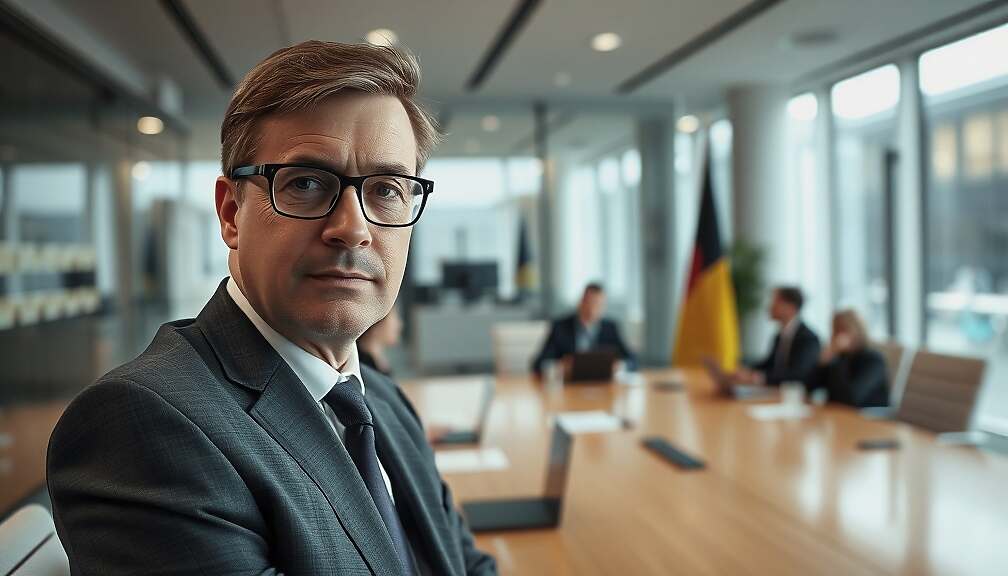
The Federal Minister of Economic Affairs, Katherina Reiche (CDU), announced plans to restructure Germany’s foreign trade policy, stating that it would be made “more strategic” in a written statement provided to the dts news agency. Specifically, the overhaul will focus on establishing “new partnerships, more resilient supply chains, and clearer rules regarding foreign investments.” While affirming Germany’s openness to foreign investment, Reiche cautioned that the country would not be “blind to dependencies.”
A major milestone in this process is expected to be the government’s investor conference, planned for October, which was previously agreed upon in the coalition agreement. According to Reiche, the conference aims to attract international capital toward projects in infrastructure, Artificial Intelligence (AI), and Deep Tech.
The Minister also expects that the “Germany Fund,” supported by around 30 billion euros in public funds and guarantees, will successfully mobilize private investment, potentially totaling 130 billion euros. Speaking to the dts news agency, Reiche emphasized that “the next growth impetus will not come from new subsidies, but from new technologies, entrepreneurial courage, and private capital.”
Furthermore, foreign investment plays an increasingly crucial role in the strategy paper regularly updated by the Federal Ministry for Economic Affairs and Climate Action. This document, titled “Relieve – Unleash – Renew” (Entlasten – Entfesseln – Erneuern), reviews performance since the government changed and outlines future initiatives. The August version of this document was provided to the dts news agency.
Within this strategy paper, the investor conference, alongside the Davos House at the World Economic Forum in January 2027, is cited as one of three central themes for the coming months-the others being the implementation of the new Renewable Energy Sources Act (EEG) and the establishment of strategic gas reserves starting in winter 2027.
For the period spanning 2028 to 2031, the Ministry sets specific goals and projects: to expand the Germany Fund; to continue the WIN initiative and double the mobilized capital to over 25 billion euros; to ratify agreements with India and Australia; and to gradually expand the H2 core network and import corridors based on demand. Finally, a “start of a technology-neutral, market-based capacity market” is planned for 2032.