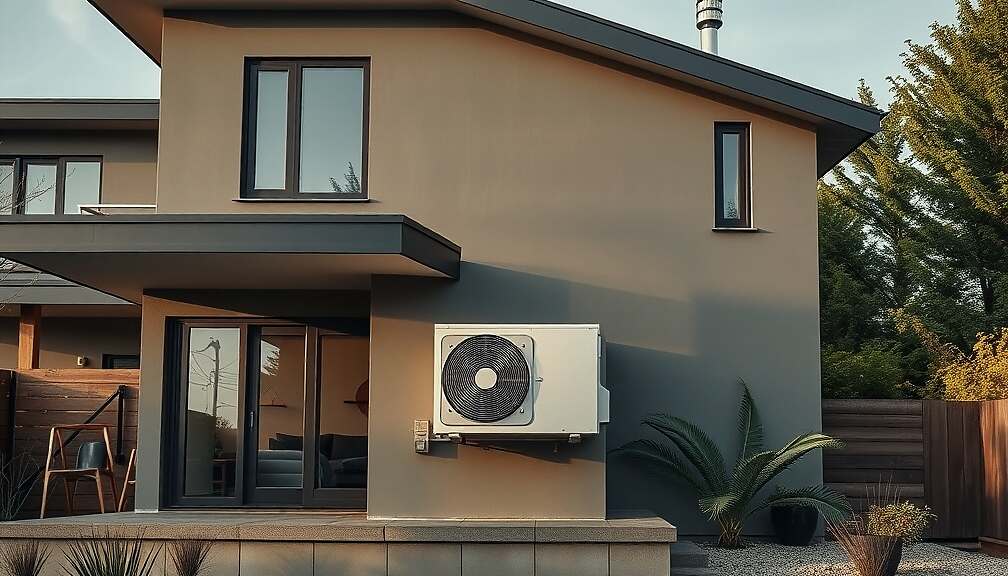
According to a study published by the WWF, installing a heat pump could become financially advantageous even in a poorly insulated single-family home after just a few years. The Funke-Mediengruppe reported on this new model calculation conducted by the environmental organization. The analysis concludes that, when combined with a photovoltaic system and utilizing maximum state subsidies, a heat pump pays for itself in four years compared to installing a new gas boiler. Even without solar panels, the study indicates the heat pump remains a more cost-effective long-term option.
Experts compared the acquisition and operating costs of a new gas boiler against an air-to-water heat pump. The baseline for this comparison was a partially renovated single-family home classified at energy efficiency class F. For the heat pump, the projected initial cost, including surrounding necessary measures, was around 43,000 Euros, while a comparable new gas boiler was estimated to cost 18,000 Euros.
Initially, a maximum of 28,000 Euros is eligible for subsidies for the heat pump. There is no state subsidy available for gas boilers. The experts factored an optional photovoltaic system into the calculation with an additional cost of approximately 10,100 Euros. Furthermore, the gas boiler model accounts for the gradual inclusion of biomethane, starting in 2029, as well as increasing gas network charges and CO2 prices. These rising operational costs for gas are a major factor contributing to the heat pump’s long-term cost advantage.
Over a 15-year period, the heat pump proves to be cheaper across all examined subsidy scenarios if the investment is made in October 2026. Without a government income bonus, the savings compared to gas are estimated at around 4,300 Euros if no PV system is installed, and about 6,200 Euros if a solar system is included. If a 40 percent income bonus is applied, the cost benefit increases significantly to around 13,800 Euros, or 15,700 Euros with solar power.
However, the authors issue a warning regarding the financial disadvantages that homeowners face if they delay the heating system replacement. Subsidies for heat pumps are gradually decreasing. According to the WWF, if someone chooses to invest in August 2028, they may see a lower cost advantage-ranging from 4,600 to 5,380 Euros-compared to making the installation in October 2026. Furthermore, after August 2028, the climate speed bonus will be completely removed. The extent of the worsening economy depends on the subsidy amount and the use of a PV system. In fact, according to the model calculation, delaying the investment without an income bonus and without PV systems could result in extra costs of around 800 Euros over 15 years compared to a new gas boiler.
The analysis takes into account the changes to the federal efficiency building subsidy that came into effect in July 2026. These subsidies are now more heavily oriented towards household income and situation, and the maximum allowable investment costs are also being reduced. Sebastian Breer, an energy expert at the WWF, emphasized the critical need to secure this funding in the federal budget for the long term. He stressed that acting in a climate-friendly way today is also financially prudent. He added that replacing the boiler also reduces dependence on fossil energy imports and, consequently, on geopolitical crises. Despite this, the environmental organization believes that the higher initial investment costs of a heat pump remain a substantial barrier.
The WWF also stressed that the findings are not universally applicable to every building. The economic viability depends on various factors, including the condition of the house, the required energy consumption, the specific subsidies available, and the financing method. Moreover, the model calculation does not account for potential price increases for fossil fuels resulting from ongoing or new geopolitical crises. Therefore, the organization recommends that consumers seek independent energy consulting before making a decision about a new heating system.