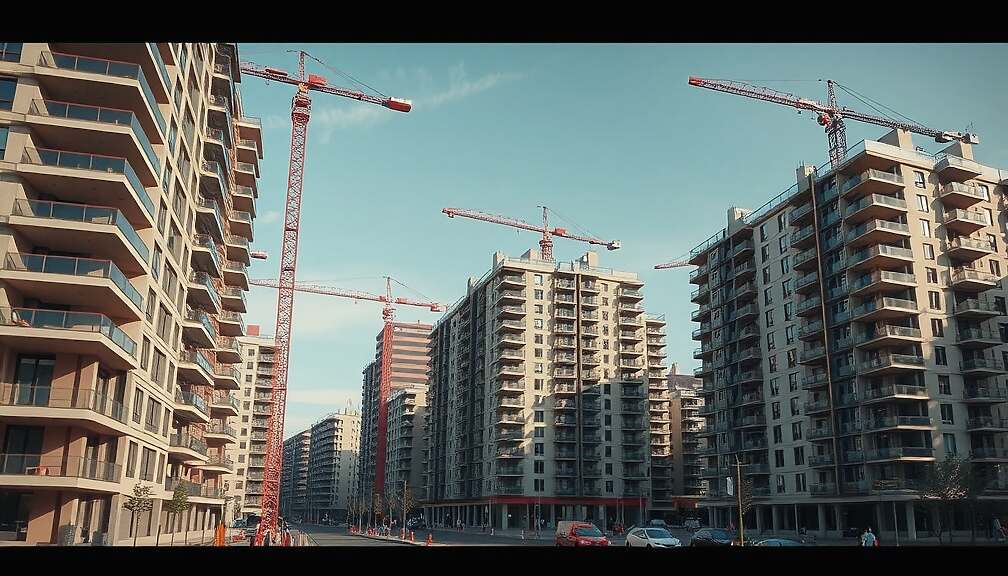
According to the Federal Statistical Office (Destatis), housing construction permits are increasing across various categories. For the period of January to March 2026, 63,500 dwellings-in both new and existing buildings-were permitted in Germany. This represents a significant rise of 14.6 percent, or 8,100 more units, compared to the same period in 2025.
Focusing only on the month of March 2026, a total of 21,800 construction permits were approved. This monthly figure showed an increase of 11.5 percent, or 2,200 more permits, than was recorded in March 2025. This monthly total was split between new construction and refurbishments.
In new builds, 17,600 dwellings were permitted in March 2026, an increase of 8.2 percent, or 1,300 units. For improvements to existing structures, the number rose substantially by 28.0 percent, or 900 units, reaching 4,200 dwellings.
Looking at the full first quarter (January-March), the number of totally new residential buildings permitted was 51,700 dwellings, marking a 14.0 percent increase or 6,300 more units than the prior year. Within this segment, single-family homes saw a significant jump of 13.7 percent (+1,500 permits) to 12,100 units. Two-family homes followed suit, with a 23.2 percent increase (+700 permits) bringing the total to 3,600. Multi-family homes, the largest segment by volume, saw development authorities permit 33,100 new dwellings, representing a rise of 14.9 percent (+4,300 units) year-over-year. Conversely, residential facilities (dormitories) saw a slight decrease, declining by 3.1 percent (-100 units) to 2,800 units.
Alongside residential construction, 1,400 units were permitted for new non-residential buildings (such as caretaker apartments in schools or inner-city dwellings built over commercial spaces), representing an increase of 73.7 percent (+600 units) compared to the previous year. Addressing older structures, 10,500 dwellings were permitted for renovations across existing residential and non-residential buildings, an increase of 12.3 percent or 1,200 units compared to Q1 of 2025.