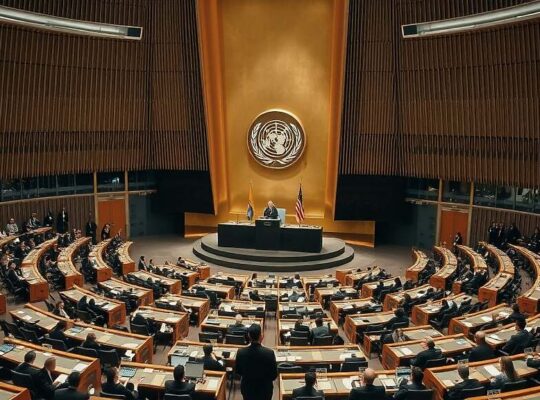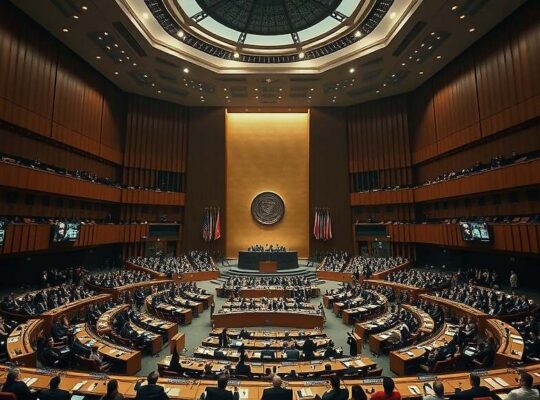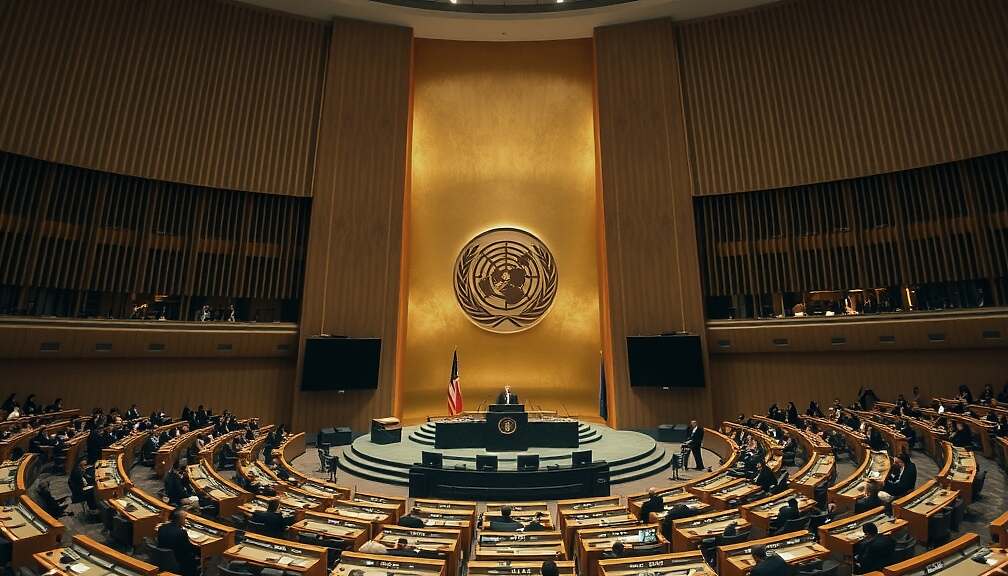
Iranian President Massoud Pezeshkian delivered a sharp condemnation of both the United States and Israel during his address to the United Nations, a speech which was briefly interrupted when the last American representative exited the chamber shortly after it began.
Responding directly to previous remarks by US President Donald Trump, who had labeled Iranians as “terrorists,” Pezeshkian asserted that Iran itself is a victim of violence and aggression. He highlighted the deaths of various Iranian regime leaders and civilians, using visual aids during his presentation. Pezeshkian leveled the accusation that “Israel targets every neighborhood in every city, in every province, and commits assassinations like a true terrorist.”
The Iranian leader heavily criticized what he deemed a profound double standard regarding his country. While Israel possesses nuclear and atomic weapons, he pointed out that inspectors are only asked to visit Iran. He stated that Israel has brutally murdered tens of thousands of innocent people in Gaza, yet Iran was simultaneously being bombed while seated at the negotiating table. According to Peseshkian, Israel holds weapons of mass destruction, yet no member of the Nuclear Non-Proliferation Treaty (NPT) has allowed a single inspection in their “disgraceful lives,” even though they are rewarded for arbitrarily bombing regional capitals.
Addressing the matter of nuclear technology, Pezeshkian defended Iran’s program, emphasizing its entirely peaceful and civilian applications. He argued that for his nation, nuclear technology represents intrinsic progress: it provides healing and treatment for the sick, ensures food security for the agricultural sector, and drives progress and electrical energy supplies for industry. He rejected the notion that nuclear technology should be reserved for just a few countries, stating clearly: “We will not bow down and give up the right that naturally belongs to us. We state it clearly: No nuclear weapons and no restrictions on new peaceful nuclear technology.”
Furthermore, Pezeshkian devoted substantial time to Gaza, accusing both the United States and Israel of committing “genocide.” He reported that over 80,000 innocent civilians had been brutally killed in Gaza, and hundreds of thousands displaced. He argued that they perpetrate genocide using the technologies at their disposal, only to label others as terrorists.
The Iranian President characterized Palestine as “an open wound in the conscience of the international community,” naming Gaza a “symbol of the failure of international mechanisms to prevent civilian suffering.” He stressed that lasting peace in West Asia is impossible without justice for Palestine, and as long as occupation, aggression, and injustice persist, resistance will continue. He concluded that, despite incessant killing and widespread devastation, the people in Gaza have seen their faith in resistance strengthened, something that cannot be destroyed by bombs or sieges because “that is human nature.”
Wrapping up his speech, Pezeshkian called for international collaboration, making sure to emphasize that this outreach was not born of weakness. He stated, “Iran extends a hand to the world. We invite the world, we call upon the world-not out of weakness, but out of deep faith in our own strength and steadfastness.” He finished with a stark ultimatum: “Either we build security together, or we will have to live together in uncertainty.”