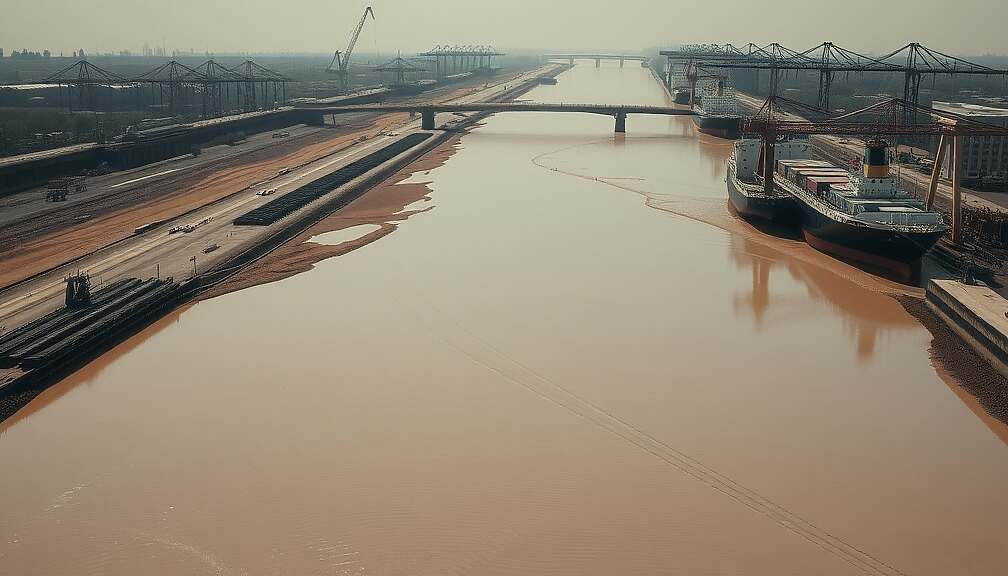
The prolonged low water levels in the Rhine are projected to cause production losses of approximately 913 million euros for the German economy by the end of October. This calculation, provided by the consulting firm Prognos for the “Handelsblatt”, suggests that the overall value created in the Rhine basin could decline by nearly 214 million euros.
The chemical industry is forecast to be the hardest hit, accounting for almost 47 percent of the potential production shortfalls, totaling around 426 million euros. Prognos estimates that coke plants and mineral oil processing facilities alone will experience losses of nearly 207 million euros. Following these are the utilities and supply sectors, with losses projected at 49 million euros, and logistics, trade, and hospitality, which face an estimated reduction of nearly 48 million euros.
Specific regions face notable risks. The industrial area of Mannheim-Ludwigshafen is particularly vulnerable, facing potential production losses exceeding 494 million euros. Prognos estimates the risk for the Rhine-Main region at 136 million euros, while Karlsruhe is expected to suffer nearly 118 million euros in losses.
These figures are based on water level measurements taken up to July 30th in Kaub near Koblenz and Duisburg-Ruhrort, alongside a six-week forecast from the Federal Institute of Hydrology. Prognos further modeled the subsequent course up to the end of October using seasonal patterns from 1990 to 2019. However, the accuracy of the longer-term projection remains heavily dependent on future rainfall.
Yet, this drought is only the most visible symptom of a larger issue. Beyond the rivers, pressure on water resources is increasing. Companies are preparing for stricter requirements regarding water abstraction, investing in recycling, and exploring alternative sources. Simultaneously, new major consumers, such as data centers, are heightening the competition. Consequently, experts anticipate that conflicts over water resources will intensify, raising questions about which locations can be reliably supplied in the future.