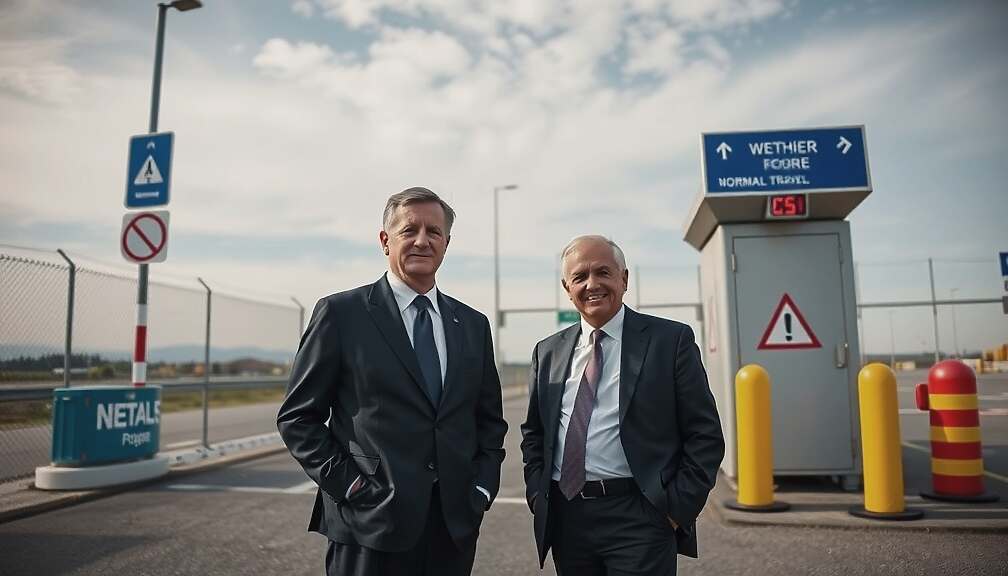
Following the announcement by Federal Interior Minister Alexander Dobrindt (CSU) that he intends to maintain border controls, the SPD reiterated that such measures should remain temporary. Sebastian Fiedler, the SPD’s parliamentary spokesperson on domestic politics, told the “Welt” that while internal border checks can be useful in certain situations, they cannot become permanent. He argued that the personnel deployed for these checks must be scaled back gradually and replaced with significantly smarter, intelligence-based controls. Fiedler emphasized the importance of “strengthening European solutions and cleverly balancing national measures”.
Dobrindt had previously stated in the “Rheinische Post” that he wished to maintain border controls, even though there were currently no flight movements into Germany following the Iran War.
Fiedler added that there is a “real security problem at train stations and in trains”. He claimed that everyday safety isn’t achieved through border checks but primarily through personnel presence where people are traveling, an area that urgently requires reinforcement.
Support for Dobrindt’s stance comes from the Union. Alexander Throm, the Union’s parliamentary spokesperson on domestic politics, told the “Welt” that “the migration shift is no longer just an announcement; it is happening”. He stated the current priority is to solidify this approach permanently and secure Germany and Europe against potential new migration pressures. To achieve this, he argued, the EU’s external borders must be secured, and the Common European Asylum System must be implemented. However, he added that until central rules-particularly those related to the Dublin Regulation-are reliably applied, controls at internal borders remain necessary, a policy, he noted, that was agreed upon in the coalition contract.
The AfD, however, deems the black-red approach insufficient. The party instead demands the withdrawal of all protection statuses for Syrians in Germany following the regime change in Syria and the deportation of non-naturalized citizens. Gottfried Curio, the AfD’s parliamentary spokesperson on domestic politics, told the “Welt” that the reduced pressure from new Syrian asylum applicants is attributable to the regime change, and “in no way-contrary to Dobrindt’s suggestions-is it due to any activity by this federal government”. Curio contended that the border controls were marked by “complete ineffectiveness” accusing both Dobrindt and Merz of intentionally misleading the German electorate about a non-existent “migration shift”.
Meanwhile, Die Linke expressed “significant legal doubts” regarding the internal border controls. Clara Bünger, the deputy head of the Linke faction, told the “Welt” that Dobrindt acted illegally if he allowed for the blanket rejection of asylum seekers at the borders, noting that courts had already clarified this point. She stated that “making policy like this prioritizes enclosure over the rule of law”. Furthermore, she argued that deportations to Afghanistan should be refused due to the Taliban’s rule. Bünger accused Dobrindt of “copying the AfD’s politics” and thereby strengthening the right-wing extremist party. Instead, she insisted that “the everyday problems of people must be the focus”. Regarding migration policy, she argued that the black-red coalition must focus on strengthening “legal paths, participation, and regularization” rather than working with “fear, enclosure, and authoritarian noise”.