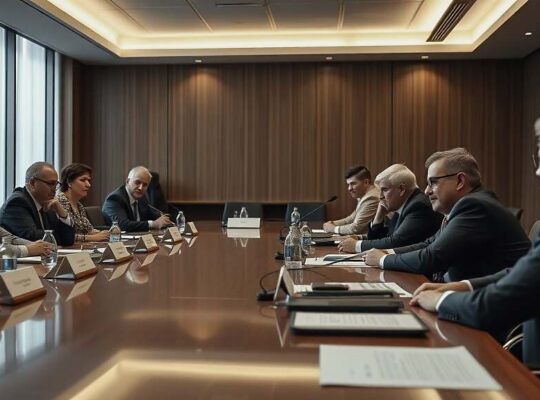
Peter Voser, the Chairman of the Board of Directors at the Swiss technology conglomerate ABB, argues that the success story of Switzerland is threatened if the nation accepts the anti-immigration initiative put forward by the national conservative Swiss People’s Party (SVP) on June 14th. This initiative proposes capping the Swiss population at ten million.
Speaking to the “Frankfurter Allgemeine Zeitung”, Voser stated that Switzerland’s success as an export-oriented economy relies heavily on openness. He emphasized the country’s dependence on foreign skilled labor, noting that the pool of qualified personnel is simply too small in their small country, especially as the Baby Boomer generation begins to leave the workforce in the coming years. Voser countered the potential solution offered by the cap, asserting that it would not resolve the issues it purports to address. He stressed that the scarcity of housing and high rents should not be blamed solely on immigration, adding, “Swiss citizens are living on a larger budget today than previously”.
Currently, Switzerland has a population of 9.1 million. According to the initiative, measures such as restricting family reunification would need to be implemented once the threshold of 9.5 million is reached. When asked about the potential consequences, Voser warned that “Switzerland would lose its attractiveness”. He posed a critical question: “What kind of skilled professional would still move to Switzerland if they were not allowed to bring their family? Most immigrants already have a job contract. If they stop coming, the economy will suffer”.
Voser further highlighted that reaching the ten-million threshold would necessitate the termination of the Free Movement of Persons agreement with the EU. He explained that this agreement is inseparable from other crucial bilateral EU treaties, which have been fundamental to Switzerland’s access to the European single market and have driven significant growth. In his view, this success story is endangered by the ten-million initiative.
Voser clarified that attracting individuals from abroad is not intended to lower costs; rather, it is a necessary measure to combat shortages. He noted that without immigration, the health system would fail, and that construction and the hospitality sector could not function without foreign workers.
Regarding ABB’s corporate structure, where Voser is the only native Swiss among the 18 members of the board and administrative council, he dismissed the idea that his presence would favor the initiative’s proponents. He explained, “No, I don’t see it that way. ABB is a global company that generates more than 95 percent of its revenue outside Switzerland. We are very international, and this is reflected in our leadership”. He asserted that the company requires a management team and a board capable of covering the global strategy and configuration of the corporation.
Finally, Voser strongly supported the proposed new contract package with the EU, known as Bilateral III. He stated that this package is vital for ensuring legal certainty with Switzerland’s largest trading partner. “This is especially important for the many small and medium-sized enterprises that do not have sales departments or production facilities in the EU, and who are therefore dependent on the frictionless export of their goods” he added. Without this advantage, these affected businesses would be more likely to invest abroad rather than in Switzerland.