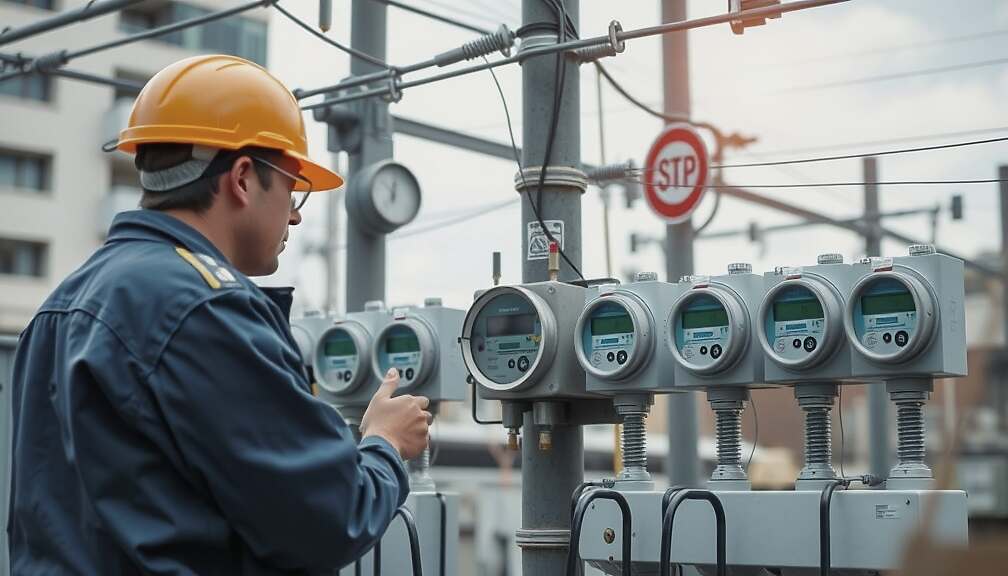
The Federal Network Agency (Bundesnetzagentur) began enforcement proceedings in March against 77 network operators accused of failing to install smart electricity meters. According to Klaus Müller, the President of the Agency, the issue is not about companies struggling, but about operational failings regarding clear statutory deadlines. Speaking on the podcast “Klima-Labor” Müller warned that if progress is not seen, future measures will explicitly involve financial penalties.
Müller stated that his agency had been quarterly assessing the deployment progress over the past year, requiring at least four milestones to successfully calculate and accelerate the rollout. Despite this effort, numerous companies had failed to initiate the necessary scale-up.
When questioned about the reaction to the investigations, Müller recounted receiving excuses from the affected companies, such as, “it all ran badly”. He dismissed this response, insisting that the focus must remain on establishing when the 77 companies will fulfill their mandated duties. While he conceded that smaller network operators often struggle, delaying the installation deadlines, such issues are not to be accepted as excuses. He pointed out that these smaller providers could have easily contracted external service providers to manage the rollout.
However, the Agency highlighted positive examples, such as the city utility Lübz, which became the first metering service operator in Germany in 2024 to achieve 100% compliance coverage.
In Germany, the mandate for installing smart meters follows a selective rollout process, differing from many European neighbors. Initially, the 813 foundational metering service providers must equip all private and commercial users who annually consume more than 6,000 kilowatt-hours. Affected users also include those generating more than 7 kilowatts of electricity, as well as households possessing controllable devices like heat pumps or battery storage systems.
The target goal for mandatory installation coverage is set at 90% by the end of 2032, with an interim goal of 20% for the end of 2025. The German rollout has exceeded this 2025 target nationwide; according to the Federal Network Agency, 23.3% of mandatory cases are currently equipped with a smart meter. If all meters in residential and commercial buildings are counted, the overall installation rate stands at 5.5%.
Due to this pace, Germany currently ranks among the slowest countries in Europe regarding the smart meter rollout. For comparison, Denmark and Sweden had already equipped all households with smart meters by 2021. At that time, Estonia, Finland, Italy, Luxembourg, Norway, and Spain had reached 98% coverage, while France, Latvia, Lithuania, Malta, the Netherlands, and Slovenia had surpassed 80%.