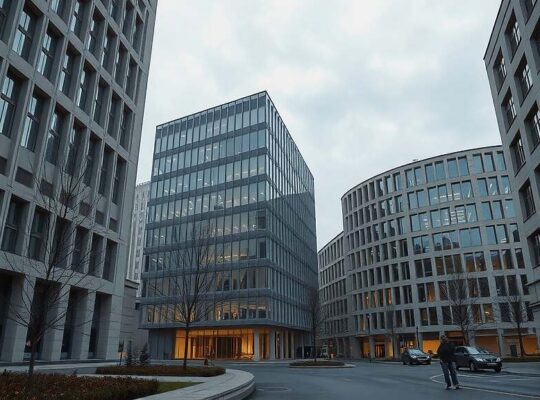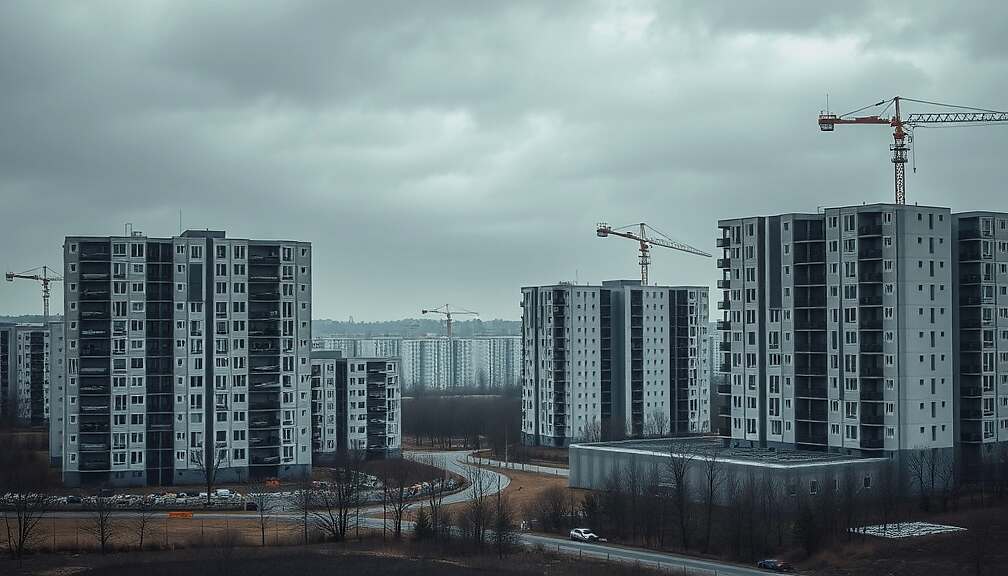
In 2025, approximately 206,600 residential units were completed in Germany, an 18.0% decrease or 45,400 fewer units than the previous year, according to data released by the Federal Statistical Office (Destatis) on Friday. This marks a significant decline for the second consecutive year (with a drop of 14.4% in 2024), following a period between 2021 and 2023 where completions were stable at around 294,000 units annually. Previously, the number of new homes had risen from a low of 159,000 in 2009 to a peak of 306,400 in 2020, though the most recent low point before 2025 was in 2012 (200,500 units). These figures encompass both units in new and existing buildings.
Within newly constructed residential buildings, 172,600 apartments were finished in 2025, which was 20.0% fewer-or 43,300 less-than the preceding year. Reductions were observed across various housing types: single-family homes, primarily built by private individuals, saw a 23.3% drop (12,700 fewer units), while twin-family homes decreased by 21.4% (3,800 fewer units), totaling 13,800 units. The largest category, multi-family homes, generated 109,800 new units, representing an 18.9% decrease (25,500 fewer units) compared to 2024. In new residential dormitories, completed units fell by 15.1% (1,300 fewer), reaching 7,200. Furthermore, 3,300 apartments were created in new non-residential structures, marking a 31.8% decline or 1,500 fewer units than in 2024 (e.g., caretakers’ apartments in schools or city-center units over commercial spaces).
As a renovation project in existing residential and non-residential structures, 30,700 units were completed in 2025, a slight decrease of 1.8% or 600 units compared to 2024.
Geographically, the decline in newly built residential units was steeper in the East than in the West. While the number of completions in the West decreased by 16.7% (down 29,200 units to 145,700), the number in the East dropped by 34.3% (down 14,000 units to 26,900). This disparity was particularly pronounced in multi-family homes: West Germany saw a 13.9% reduction (15,000 fewer units), compared to 38.3% in the East (10,600 fewer units).
When broken down by developer group, companies accounted for 89,500 of the new units in 2025, a decrease of 17.8% or 19,400 units from the previous year. Private individuals were responsible for 72,300 units, a decline of 23.7% or 22,400. Public sector entities completed 7,900 new units (down 15.6% or 1,500), while non-profit organizations contributed 2,900 (up 1.7% or 50).
Several trends signal increasing construction duration and smaller living spaces. The average processing time for new residential construction-from approval to completion-extended in 2025 to 27 months. This was longer than the 26 months recorded in 2024 and substantially longer than the mere 20 months in 2020. Regarding size, the average living area for a new apartment in 2025 measured 95.2 square meters, continuing the trend toward smaller dwellings. This contrasts with the largest average size ever measured, which was 116.4 square meters in 2007.
Looking at permits versus actual construction, residential building approvals rose by 10.6% in 2025 compared to the previous year, reaching 238,100. This number exceeded the quantity of completed units. By the end of 2025, the construction backlog-units approved but not yet finished-stood at 760,700, which maintained 2024 levels (759,700). Of this backlog, 307,200 units were actively under construction, with 158,600 of those in the shell construction phase. Furthermore, 35,700 building permits were issued in 2025, achieving the highest figure since 2002-an increase of about a quarter compared to 2024, and roughly half compared to 2022 and 2023.
Construction activity for non-residential buildings (such as factories, warehouses, or administrative offices) also saw a decline in 2025. The key indicator for this activity is restructured space. The volume of repurposed space in non-residential buildings finished in 2025 shrank by 3.8% compared to 2024, reaching 170.9 million cubic meters. The strongest decline was seen in commercial and administrative buildings, which dropped by 19.5%, reported the Federal Office.