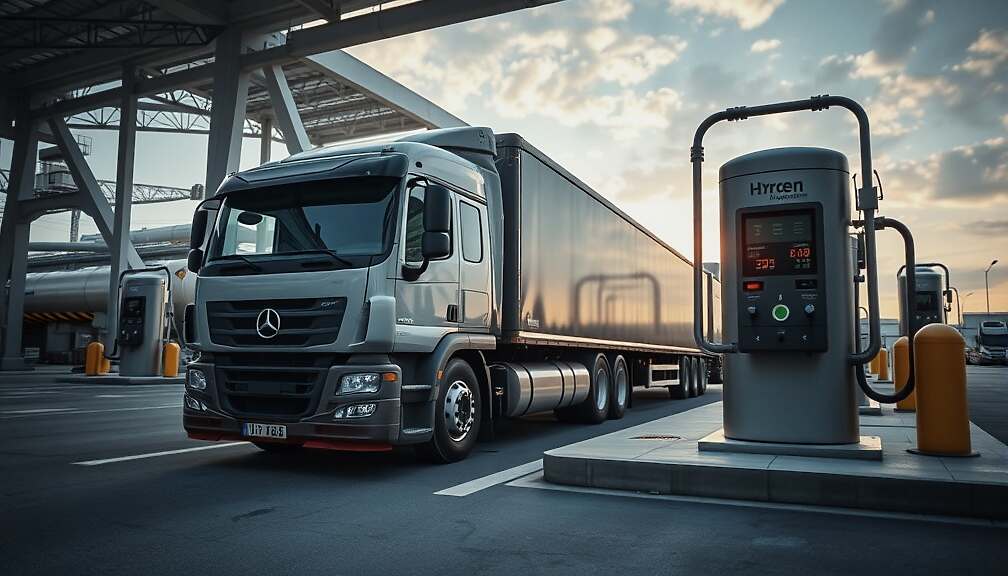
Germany’s Federal Minister for Transport, Patrick Schnieder (CDU), recently highlighted the advancements made in establishing a hydrogen fueling network for heavy commercial vehicles. According to Schnieder, the strong interest shown in response to the initiative to build an initial network for fueling heavy trucks proves that “we are coming at exactly the right time with our approach.” He emphasized that while the industry is focusing on electric mobility, hydrogen mobility remains crucial for heavy-duty lorries.
The Minister stated that by combining funding for both charging stations and vehicles, they aim to provide “the decisive impulse needed to overcome the chicken-and-egg problem,” thereby setting the groundwork for a swift rollout of a climate-friendly hydrogen truck fleet.
Statistics from the Ministry of Transport indicate that by the submission deadline of June 30, 526 applications were received, requesting a total funding volume of €455 million. These applications included 71 requests for fueling stations and 455 requests for vehicles and fleets. The Federal Ministry of Transport (BMV) has put forward a total of €220 million for this initiative. Projects will be selected through a competitive process based on established criteria, with prioritized applications expected to receive approval in the second half of the year.
Furthermore, the article provided definitions for different types of hydrogen. Hydrogen is classified as “green” when it is produced by splitting water into oxygen and hydrogen, using electricity derived from renewable sources. Conversely, “blue” and “grey” hydrogen are created by decomposing methane or natural gas via steam reforming. In the case of grey hydrogen, the resulting carbon dioxide is released into the atmosphere, while blue hydrogen utilizes Carbon Capture and Storage (CCS) technology to capture and inject the CO2 underground. However, even blue hydrogen still has residual emissions; CCS only captures a portion of the output, and the extraction of the raw energy carriers itself releases climate-damaging methane.
Given that green hydrogen remains extremely scarce for the foreseeable future, scientists and environmentalists suggest limiting its use to sectors where no viable alternatives exist. These critical areas include fertilizer production, methanol synthesis, desulfurization, as well as shipping and raw steel production. While long-haul trucking is considered a borderline case, the use of hydrogen in distribution transport is viewed more cautiously.