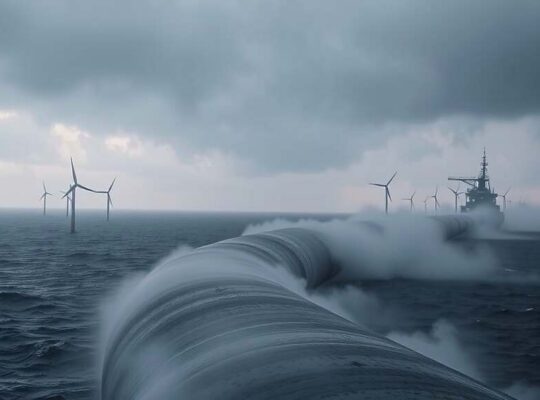
Georg Stamatelopoulos, the CEO of energy provider EnBW, has called on the German government to reduce its planned aggressive expansion of offshore wind farms in the North and Baltic Seas. He stated that while the transition to renewable energy is necessary, the government must keep affordability in mind. He argued that a lower expansion target would be a sensible correction rather than an outright stop after twenty years of planning.
The German government currently aims for a minimum of 70 gigawatts of installed capacity by 2045, with less than ten gigawatts currently online. However, Stamatelopoulos described the industry’s situation as “dramatically worsened.” He noted that costs for wind turbines, logistics, and cables have increased significantly; over five years, costs have risen by 30 to 40 percent, and the increase exceeds 50 percent over 15 years. Consequently, he proposed a revised goal: “Let’s build 55 gigawatts for now, and then we can assess the situation again.”
EnBW already operates four parks (Baltic I, Baltic II, Hohe See, and Albatros), and a fifth park, He Dreiht, is expected to add around 960 megawatts later this summer, with 55 of its 64 turbines already installed and approximately 30 operational.
Despite his call for reconsideration, Stamatelopoulos broadly defended the stance of Federal Minister for Economic Affairs Katherina Reiche (CDU). He added that the government is addressing long-standing necessary issues, and since the energy transition is a long-term project, what was correct twenty years ago is not necessarily what is right today. Nevertheless, he agreed that Reiche sometimes communicates her policies poorly.
Furthermore, he criticized the government’s planned redispatch obligation, suggesting an alternative mechanism. Instead of the government’s proposal, Stamatelopoulos suggested that operators of wind and solar parks could voluntarily waive compensation for 200 hours over a five-year period if five to ten percent of the generated electricity must be curtailed in any given year. This modification, he explained, would allow banks to more concretely estimate the risk of reduced revenue, thereby making financing the construction process significantly easier.