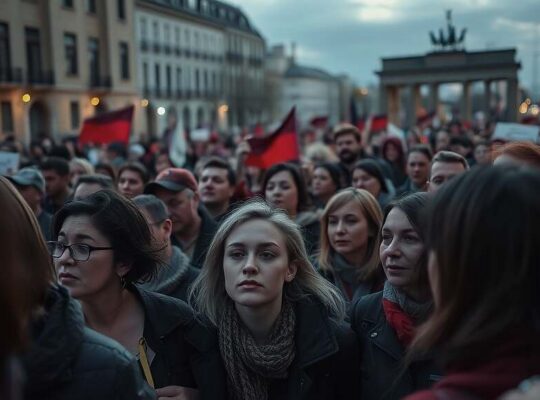
Following the anti-Islamic and homophobic terror attack on Berlin’s Christopher Street Day, SPD faction leader Matthias Miersch has openly stated his willingness to examine the methods and powers of law enforcement agencies. Speaking to the RTL/ntv program “Frühstart” on Wednesday, he remarked that while many laws have been changed in recent years, he is “open to putting everything on the table and asking: Where are the weak points?” He specifically pointed to the fact that Germany has different police laws across various federal states as something that absolutely needs discussion.
However, Miersch shares the skepticism of fellow internal affairs politician Sebastian Fiedler (SPD) regarding the tightening of juvenile criminal law. The faction leader emphasized that laws must be applied, and judges and prosecutors inherently need a degree of flexibility. “You cannot dictate every single thing line-for-line when you are the legislator,” Miersch stated. He added that it is honest to acknowledge these existing areas of discretion, which is why he is skeptical of overly strict changes. That said, he believes that discussions are essential regarding which powers law enforcement agencies are given to deal with high-risk individuals and whether those powers are adequate.
In the wake of the attack, Miersch also advocated for amending Article 3 of the German Basic Law (the Constitution) to explicitly include the characteristic of sexual identity. He argues that the Constitution is the paramount asset of the rule of law. “And here, specifying Article Three again, that we do not want any disadvantage based on sexual identity-that would send a clear signal. That is why we are advocating for it,” he explained.
Currently, Article 3, Paragraph 3 of the Basic Law states that no one may be subjected to disadvantage or preference because of their gender, descent, race, language, homeland and origin, beliefs, or religious or political opinions. No one may be disadvantaged because of a disability. Many groups, reacting to the persecution of minorities during the National Socialist era, have been incorporated into this ban on discrimination. However, queer people, as well as (mentally) ill individuals and several groups previously socially excluded as “asocials” or “professional criminals,” are not currently included.