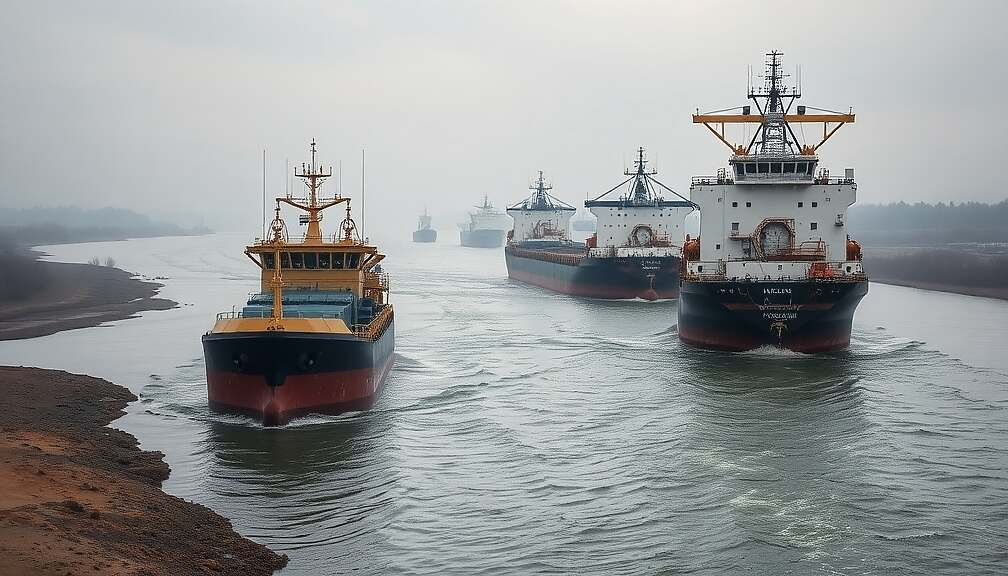
The economic damage caused by the low water levels could be significantly greater than previously feared, primarily due to the potential interruption of continuous shipping traffic on the Rhine. Nils Jannsen, a business researcher at the Kiel Institute for the World Economy (IfW), told the FAZ that a shutdown falls outside the scope of their current projections, warning that such a scenario could result in visibly larger, disproportionate consequences. Initially, the institute had estimated that a low water level lasting 30 days would shave 0.3 percent off German economic output.
Jannsen noted that it is not yet possible to seriously quantify how much this forecast would need to be increased if shipping were to cease, highlighting the uncertainty regarding the extent to which companies can utilize alternative supply routes for raw materials or compensate for lost production.
These new concerns were triggered by an alarm call from the Federal Association of German Inland Shipping (BDB). Due to the ongoing low water levels and further predicted drops in water levels, the Rhine could effectively be partitioned for commercial use.
Despite the recent removal of weekend truck bans by four German states-Lower Saxony, North Rhine-Westphalia, Rhineland-Palatinate, and Saarland-to boost road freight, this effort is described as “illusory” by Klaus Wohlrabe, an economic researcher at the Munich Ifo Institute. He insisted that simply moving drivers from Sunday to Monday does not bring more goods into factories and that the existing shortage of drivers is not something that can be resolved quickly. When asked what short-term political actions could be taken, Wohlrabe stated that “nothing” could be done immediately. Measures such as deepening navigation channels, currently under discussion, would only yield results in the medium term.
Additionally, the question of whether the Bundeswehr (German Armed Forces) could intervene to alleviate the driver shortage was raised. Kiel’s Stefan Kooths suggested that this might be an option in the current situation, provided that freight companies could cover the necessary compensation and the Bundeswehr could actually spare the drivers. However, Kooths cautioned that it is fundamentally not the role of the Bundeswehr to act as a silent reserve capacity for the economy.
He emphasized that production companies must primarily adapt to changing transport conditions, whether through increasing inventory or employing alternative transport routes. The state, as the provider of inland waterway infrastructure, also has a role to play in resolving bottlenecks and facilitating deepening. Kooths sternly warned against the signal that might be sent if the Bundeswehr were used in a real-economy bailout capacity: that it was designed to “scoop the coal out of the fire” during an emergency.