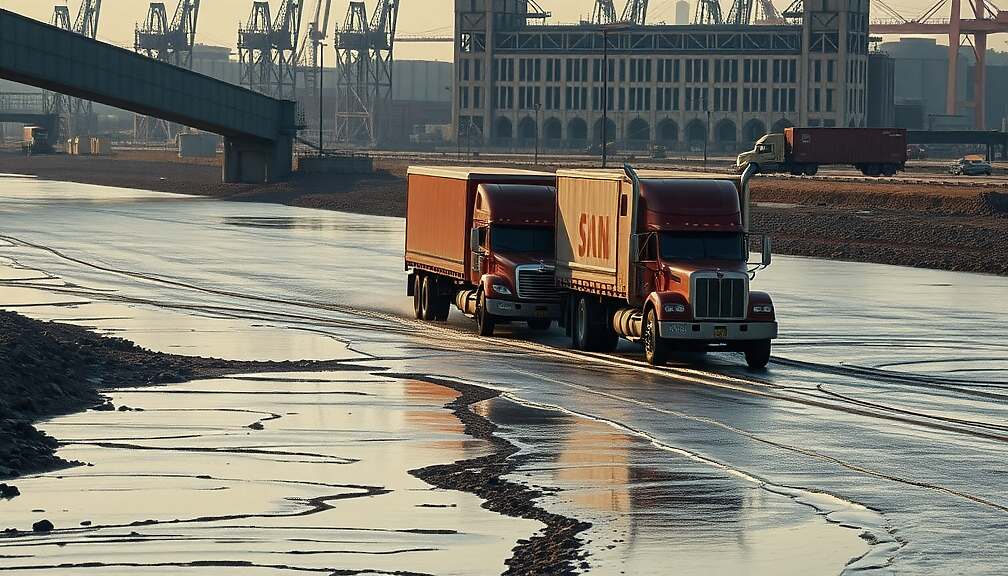
The relaxation of Sunday driving bans for trucks, implemented by several federal states, is unlikely to have a significantly measurable effect on mitigating the consequences of the low water levels on the Rhine, according to economic expert Thomas Puls of the Cologne Institute for the German Economy (IW).
Puls stated to “Spiegel” that he does not expect a noticeable shift in traffic onto the roads. Several factors contribute to this limited impact. First, a single inland vessel can replace between 150 trucks, and large convoys can replace even more. Furthermore, essential goods that are typically transported on the water-such as mineral oil products, sand, gravel, ore, or chemicals-cannot all be moved by standard tractor-trailers.
Puls noted that specialized vehicles, such as tanker trucks or dumpers, are required for this transport. These specific vehicles are rarely found in the fleets of commercial transport companies. Compounding this issue is the ongoing shortage of truck drivers, with industry associations estimating that the country currently lacks 100,000 drivers.
The available number of trucks cannot be sufficiently replaced by providers from the European market either. Puls explained that foreign trucks operating in Germany are primarily standard trailers for containers and pallets, which offers only partial assistance. Finally, he dismissed the concern raised by the ADAC regarding additional traffic jams resulting from these relaxations, arguing that peak travel traffic during the summer months is already sufficient to cause congestion.