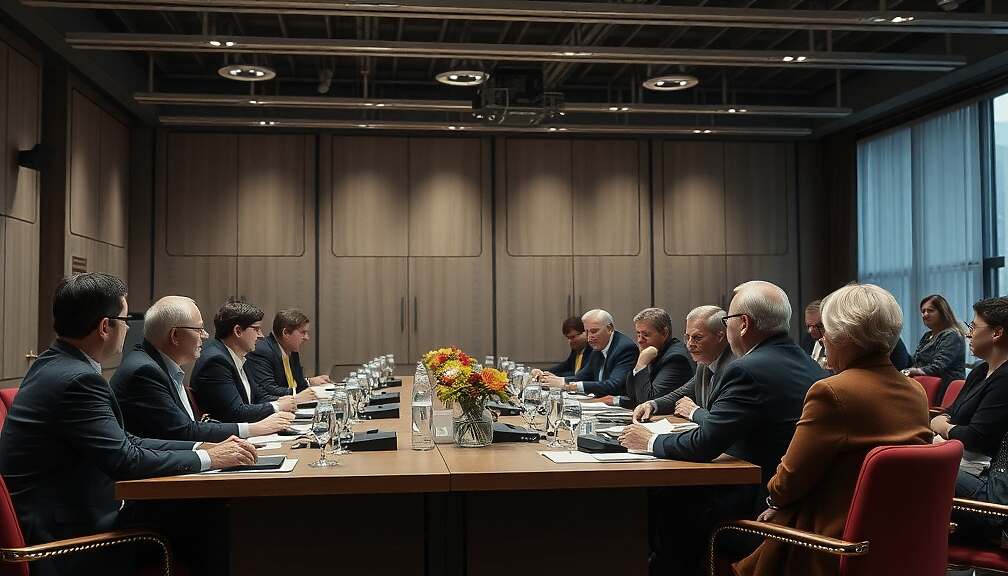
Leading candidates for the state elections in Saxony-Anhalt recently presented their positions on the issues of the labor market, education, and bureaucratic reduction during a political dialogue hosted by the IHK Halle-Dessau Chamber of Industry and Commerce.
Sven Schulze of the CDU highlighted the ongoing administrative reforms, asserting that the reduction of bureaucracy would be greater than ever before. He stated that any entity wishing to maintain reporting obligations in the new legislative period must prove their necessity. Furthermore, he advocated for increasing the practical application component in school curricula.
Conversely, Frank Scharfenort (AfD), speaking on behalf of AfD candidate Ulrich Siegmund, campaigned for streamlining the administration. On the topic of skilled labor immigration, he proposed a strict distinction between asylum seekers and workers, suggesting the creation of a specific “deportation detention center.” His approach to bureaucracy reduction involves setting fixed terms for legislation.
Eva von Angern (Linke) strongly supported expanded early childhood education and the continuation of integrated learning models. She declared that her most significant economic policy promise is to approach economic issues holistically, arguing that good employment and public funding should not be mutually exclusive. To reduce bureaucratic processing times, she plans to increase staffing levels for authorities responsible for verification and documentation.
Armin Willingmann (SPD) stressed the importance of practical experience in education and proposed a dual-tiered school system, aiming for a closer integration between science and business. He also committed to strengthening collective bargaining agreements. The SPD politician stated he would not exacerbate existing EU or federal guidelines with additional state-level regulations, adding a warning against isolationism, given the need for skilled workers within the region.
Susan Sziborra-Seidlitz (Grüne) aims to significantly lower the rate of school dropouts and actively recruit specialized foreign labor. She emphasized the necessity of ensuring successful migration into the Saxony-Anhalt labor market. Regarding common standards and guidelines, she advocated for greater trust rather than an increase in mandatory duties.
Lydia Hüskens (FDP) called for the dismantling of procurement rules and mandated tracking of all bureaucratic expenditures. Asserting that the state should demonstrate more trust, she proclaimed her goal: “down with rules.” Additionally, she demanded enhanced early childhood education and the implementation of language proficiency tests before children start school.
Finally, Claudia Wittig (BSW) argued for establishing attractive wage conditions, contending that the skilled labor shortage cannot be overcome if local wages are inadequate. To combat teacher absenteeism and alleviate educators burdened with non-teaching duties, she proposed using a digital state portal to accelerate procedures, ensuring that citizens only have to submit documents a single time.